

The Unconstrained and Constrained Visions of Human Nature, Knowledge and Reason
- Darby Saxbe’s Advice to Steven Bartlett
- Undiagnosed
- I Am Sowellian
- Capitalism Didn’t Create Human Nature
- What Identity is Not
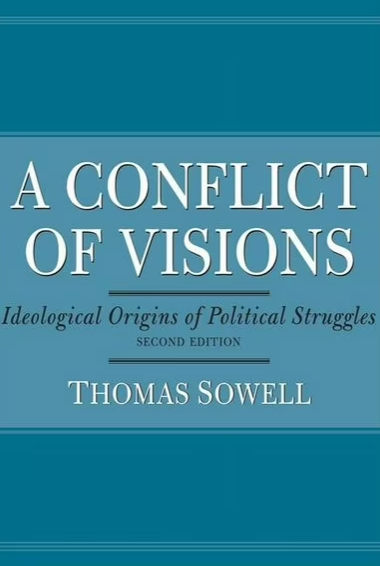
This a three-part series on “Conflict of Visions” by Thomas Sowell. It is split into the following categories of the way in which the unconstrained vision and the constrained view these subjects:
Part I: Human nature, Knowledge and Reason
Part II: Social Processes, Equality, Power
Part III: Freedom, Justice
I just completed arguably the best book I’ve ever read, excluding the Bible. In his book, Conflict of Visions, Thomas Sowell managed to lay out broadly, yet perfectly, two ways in which the world can be viewed. His impetus for writing such a book was based on a thought that plagued him; why can one predict that if someone holds one value, they will hold certain other values that are not, in any way, related? For instance, if one is pro-life, they are also pro-2A and border enforcement. Conversely, if one is anti-ICE, they are also pro-government programs, income redistribution, and socialist policies, like free healthcare. None of those things are related, barring a religious interpretation.
Once faced with this complexity, Sowell began diving in. The result was this amazing book. Sowell primarily referenced Adam Smith as an archetypal guide for the constrained vision and William Godwin as an archetypal guide for the unconstrained vision. The beauty of it may lie in the fact that no one purely resides in one vision. What we find is most people view the world mostly one way and see certain aspects of life in the view of the other vision, if they were being transparently honest. I am no exception.
“It is the lot of all human institutions, even those of the most perfect kind, to have defects as well as excellencies, ill as well as good propensities. This results from the imperfection of the institutor, man.”
“It may be a reflection on human nature that such devices should be necessary to control the abuses of government. But what is government itself but the greatest of all reflections on human nature?”
“Why has government been instituted at all? Because the passions of men will not conform to the dictates of reason and justice without constraint.”
– Alexander Hamilton in the Federalist papers
Human Nature
The unconstrained vision is focused on solutions. The constrained vision is focused on trade-offs. In the unconstrained vision, solutions are achieved when trade-offs are no longer needed.
In the unconstrained vision, man’s understanding is capable of intentionally creating social benefits. In the constrained vision, morally and socially beneficial behaviors arrive from incentives.
Given the immeasurable (or unconstrained) possibilities in human nature, poverty, or other social ills, are a result of evil intentions or blindness to solutions readily available by changing institutions. Those with constrained visions are not trying to create the ideal, but to establish the best that the people can bear.
Believers in the unconstrained vision seek the causes of war, poverty, and crime. Believers in the constrained vision seek the causes of peace, wealth, or a law-abiding society.
In the unconstrained vision, human nature can be changed and social customs and traditions are expendable holdovers from the past. Human nature is unchangeable over time in the constrained vision.
The unconstrained vision is concerned directly with results, irrespective of processes. The constrained vision is concerned with the process considered integral to desired results, but inevitably with unhappy side effects, which are accepted as trade-offs.
Summarized, a constrained vision holds that human desires exceed both personal and societal resources, and people will not voluntarily limit themselves to what society can provide. Therefore, external constraints, like prices, laws, traditions, and social pressures, are necessary to force individuals to live within real limits and reduce harm to others. These limitations apply universally, even to the wisest or most compassionate people. Only by recognizing that all humans are bound by such limits is the constrained vision complete.
Knowledge and Reason
The unconstrained vision believes knowledge is reserved for the special and elite few to serve as guides and instructors for those not blessed with above average intellect. The constrained vision believes knowledge is too vast and complex for explicit articulation. The process must travel through multiple channels, through the collection of the average many.
John Stuart Mill, through an unconstrained vision, viewed legal precedents as “an absurd sacrifice of present ends to antiquated means.” Unequal intellectual and moral standing would justify having equality imposed on others, regardless of their consent, and only “very unequal power would make it possible.” The constrained vision is less concerned with economic and social equality and more concerned with the dangers of inequality of power producing an articulate ruling elite.
A socially responsible businessman would hire the disadvantaged, invest in what is needed most by society, rather than profit, and turn proceeds over to charity in the unconstrained vision. In the constrained vision, The businessman’s competence in his particular field yields prosperity. Competition, rather than individual intentions, comprises the constrained vision and its reliance to produce social benefit.
In the unconstrained vision, the judge’s moral duty is to interpret or change the law as it fits society in the present, relinquishing the grip on the past and applying reason to the present. In the constrained vision, The judge’s moral duty is to faithfully carry out the law he was sworn to uphold, regardless of how he sees the outcome.
Conclusion
As you can see, both distinct visions share the same desired destination. Happiness and flourishing for all. The separation arrives at the mode of discretion (how the decisions are made) and the locus of discretion (who makes those decisions).
Next, we will look into the two visions and how they view Social Processes, Equality, Power.
Stay Classy GP!
Grainger