

The Subtle, Yet Glaring Distinction

- Darby Saxbe’s Advice to Steven Bartlett
- Undiagnosed
- I Am Sowellian
- Capitalism Didn’t Create Human Nature
- What Identity is Not
The distinction between collectivism and community is important. While they get conflated with each other, they’re not the same.
I recently had a couple in counseling who had hit the most common gridlock I see in couples. She says, “He doesn’t notice all I do” and he says, “No matter how much I do, it is never enough.” I asked them the last time they went on a date. They laughed and couldn’t remember. I laughed along with them in a mirroring technique helpful in counseling. But internally, I wasn’t laughing. My goal was to get fired, but for good reasons, they would no longer need me.
Thanks for reading Tidbits of Audacity! Subscribe for free to receive new posts every Tuesday.
I asked why they hadn’t gone a date recently. They quickly named off reasons that are better described as excuses. The most prevalent was not having a babysitter. I began asking about their support group. They had no such group in their lives. They were “doing fine” on their own. I retorted, “So fine that you’re in here.” They laughed again, but it was less enthusiastic.
This couple had bought into rigid individualism, losing sight of the communal necessities affording us to live our best lives.
Individualism vs Collectivism
People often discuss the juxtaposition of collectivism vs. individualism. In the West, we typically prefer individualism. After all, it is how we became the greatest nation on earth. We fought for individual freedom, demanding the government get out of our business. We originally declared the federal government good for three purposes:
- National security
- Federal banking system (states would not play nice with their separate forms of money)
- Interstate regulation (making states play nice in all areas)
So it’s easy to see how we arrived at a place where we prefer individualism over collectivism. Our ancestors witnessed the group tyrannizing the common man, and when the commons man prevailed in the Revolutionary War, individualism built roots in our soil.
But I had recently been thinking on the ways in which collectivism gets some things right, and we as individualists, tend to throw the baby out with the bathwater (Ok, no one is throwing babies. It is just an old saying). While thinking on this issue, a fellow stacker, Pastor Ron brought up an interesting point. Maybe it’s community that the collectivists got right, and maybe community exists independently of collectivism.
The Distinction
When you really step back and look at collectivism, searching for the community aspects and how they are alike, yet how they differ, quite a few things stand out.
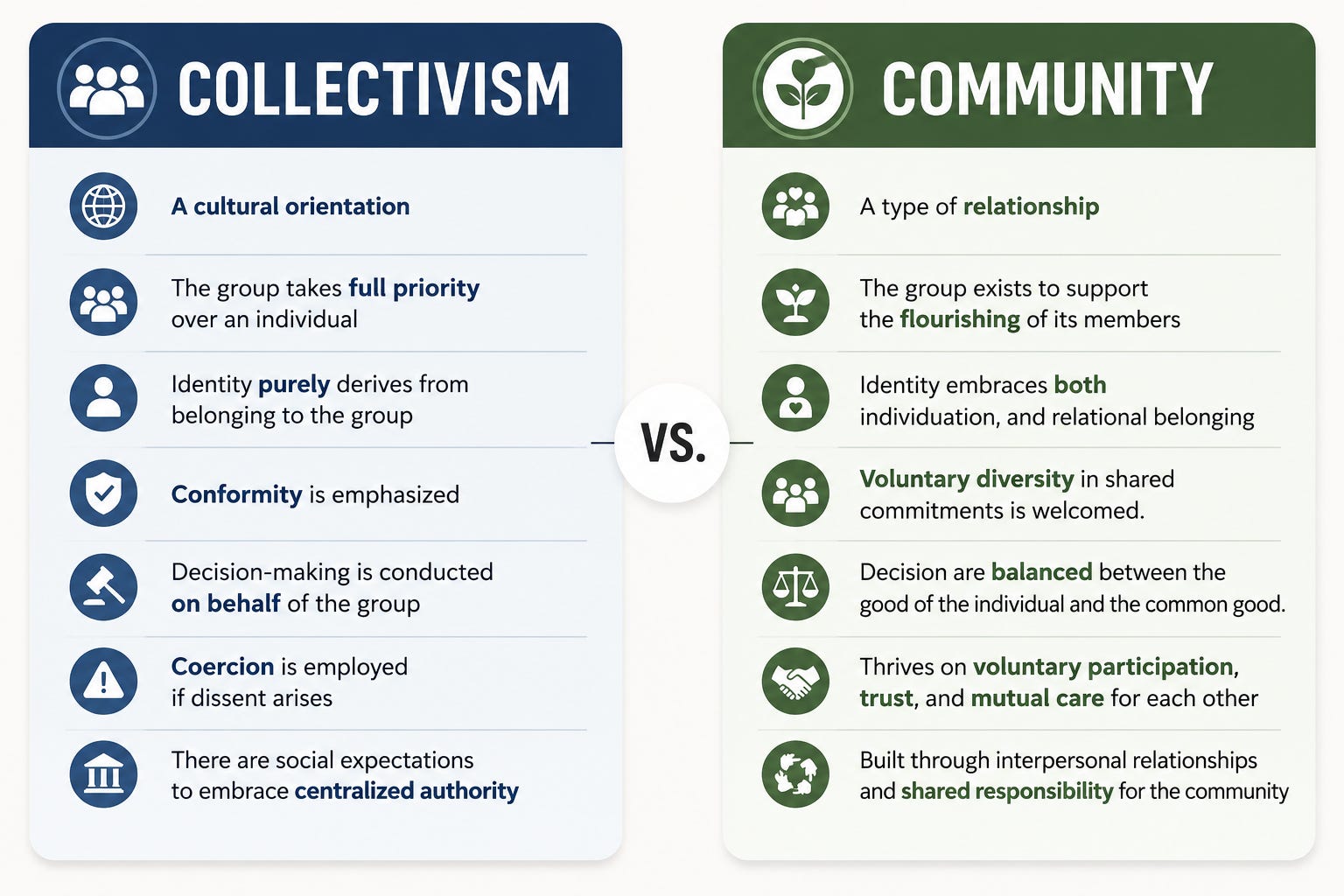
If you’re asking, “What is the best for the group?” and “How we can help each other flourish together?”— these are very different questions, particularly as it pertains to authority, agency, decision-making, autonomy, and individuation. For instance, view the distinction between the collective good vs the common good. The collective good will view and treat individuals as a means to achieve a larger social goal. The common good will recognize relationships bring out the best in individuals, while allowing agency to remain priority.
The aspects of coercion vs voluntary action, group-think vs autonomy, and even geographically remaining in close proximity vs individuation highlights distinctions between community and collectivism.
The History of Community vs Collectivism
- Alexis de Tocqueville argued that a free democracy was possible through voluntary associations like churches, neighborhoods, and local groups. He warned of the “Tyranny of the majority.”
- Robert Nisbet echoed sentiments of Tocqueville in that community consisted of aspects of voluntary participation in local groups. Nisbet believed that collectivism replaced such voluntary groups with centralized bureaucratic power.
- Pushing back on Rawlsian thinking, Michael Sandel posits that individuation is realized through social reciprocity, community, tradition, rather than existing in the form of an isolated individual. Sandel’s work is classified as communitarianism while still denouncing collectivism as viable.
- Maybe one of the more important voices on community is Robert Putnam, who writes that the erosion of community, like neighborhoods, church participation, and volunteer groups contribute to the moral decline we see today, while refusing to endorse collectivism, citing that that voluntary aspect of community is one of the core elements that make it efficacious. Putnam speaks of social capital, such as bowling leagues and churches, to find mutual aid and social reciprocity along all of its benefits, including belonging and various types of support when it is needed.
Lastly, Karl Marx was a collectivist. Enough said.
More Distinctions
Collectivism primarily focuses the interest of the group, while community focuses on mutual care, shared purpose, and the flourishing of individuals within the group. Often, social and psychological benefits commonly attributed to collectivist are actually products of good, healthy communal entities rather than prioritizing groups over all agency.
I’m firmly convinced that the protective effects often attributed to collectivist cultures can also be found in communal bonds through strong local communities, families, and churches without the requirement of coercion, loss of autonomy, or removal of individual purpose and meaning.
Conclusion
What it comes down to is, I simply don’t believe in being rigidly individual to the point of social isolation. This has been the residual effect of people unable to see benefit of communal entities like churches and support groups. They move to another town, know no one, and begin to struggle immensely with everyday household negotiation. This is because we weren’t meant to do this alone.
The phrase, “It takes a village” is needed, necessary, vital to survival and flourishing when maintaining a home, raising children, and helping our fellow neighbor in times of need. This does not require collectivist assimilation, only recognizing communal needs. My suggestion to the couple was to find community, and fast. They did. Life is better. Then they did what I always long for, they fired me.
Stay Classy GP!
Grainger