Knowing What It Is Not Helps Discover What It Is
- Darby Saxbe’s Advice to Steven Bartlett
- Undiagnosed
- I Am Sowellian
- Capitalism Didn’t Create Human Nature
- What Identity is Not
I recently wrote about what forgiveness is not. We talk a lot about identity. It is helpful to know what identity is not so we can discover what identity is. We often confuse many aspects of our lives with identity, when in reality, they’re not identity at all.
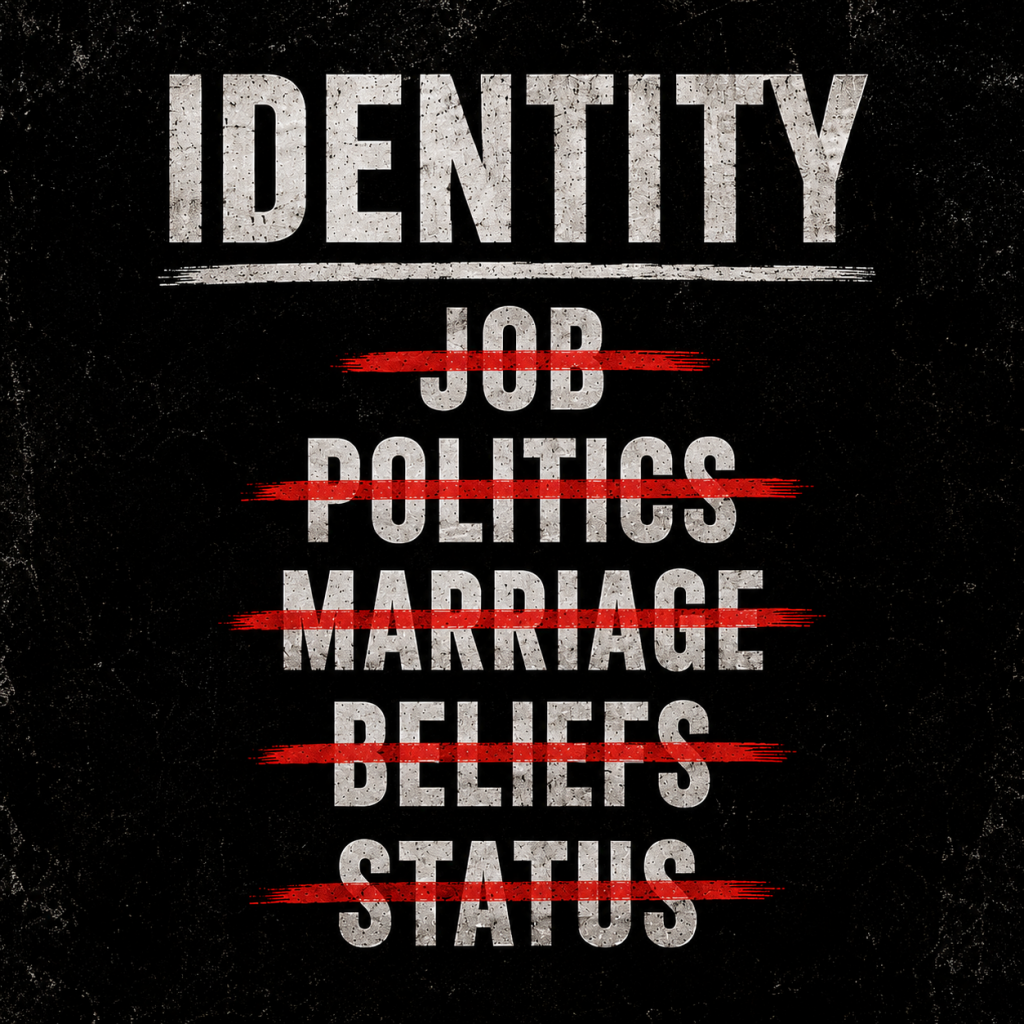
Identity Is Not Your Vocation
Vocation is an assignment, not an identity. A job can change overnight. Careers rise and fall. A title may impress people for a season, but titles are temporary. If your sense of self is rooted in what you do, then failure, retirement, unemployment, or success itself can destabilize you. Many people lose themselves because they built their identity around productivity rather than personhood. Work matters, but work is a tool, not the foundation of the self. Your vocation is meant to express something deeper already established within you. It serves your identity, not create it. You are not a teacher, writer, pastor, mechanic, or executive first. Those are functions.
Vocation is what you do, not who you are.
Identity is Not Your Belief System
Beliefs are important, but beliefs are still capable of change. Rigidity of beliefs hinder. Human beings grow through correction, learning, suffering, and experience. It’s the stretching that produces positive change. Such malleability fluctuates. A person may hold one worldview at 20 years old and another at age 40. If identity is fused completely to a belief system, then every challenge to those beliefs feels like a threat to agency itself. That elicits a defensive and fearful reaction coupled with intellectual rigidity. Proper growth requires the ability to change without losing yourself. Truth should refine us, not destroy us. A mature person allows better information to reshape flawed understanding while remaining grounded in something deeper than opinion. Identity is deeper than opinion, beliefs are not. Beliefs should serve identity, not become identity. Your beliefs can evolve while your core self remains steady, rooted, stable, and anchored beyond shifting ideas and perspectives.
Beliefs are what you hold, not who you are.
Your Identity is Not Who You Marry
Marriage is sacred and meaningful, but it is still a relationship between two changing human beings. People grow, drift, mature, fail, and sometimes leave. Death itself inevitably culminates in separation of marriage. If your identity depends entirely upon another person remaining beside you, then your foundation is fragile. Many people lose themselves inside relationships because they confuse companionship with identity. A spouse is meant to walk with you, not define your existence. Marriage can enrich life, strengthen character, and deepen love, but it cannot bear the full scope of your identity. Your value existed before marriage and remains after loss.
A spouse helps you navigate, they’re not who you are.
Your Identity is Not Being a Parent
Parenthood is one of the most meaningful responsibilities a person can experience, but yet again, a role rather than identity. Children grow older, move away, develop independence, and eventually build lives of their own. Genesis 2:24 discusses leaving one’s mother and father to join to a spouse. They will leave eventually. Some parents lose themselves (and their marriage) because their entire sense of worth becomes attached to their children’s success, affection, or need for them. When that season changes, they feel empty and disoriented. Parenting should flow from identity, not replace it. A healthy parent guides, nurtures, disciplines, and loves from a stable center rather than using children to create personal meaning. Your existence does not begin with your children, nor does it end when they leave home.
Parenting is what you do, not who you are.
Your Identity is Not Your Political Affiliation
Political systems change constantly. Parties evolve, ideologies shift, leaders disappoint, and cultural movements rise and fall. When identity becomes fused with politics, disagreement begins to feel personal and opposing views feel like attacks on internal agency. This produces hostility, tribalism, pride, and even fear. A political affiliation may reflect values or priorities, but it cannot define the eternal nature of a person. Human beings are deeper than voting patterns or ideological categories. If your identity rests in politics, then every election becomes an emotional crisis and every shift in culture threatens stability. Politics should remain a tool for engaging society rather than the foundation of self.
Politics is a malleable mechanism for interacting with broader society, not who you are.
Your Identity Comprises Your Past, Present, and Future Self
True identity must remain consistent across time. If something can disappear, change, or be taken away, then it cannot be the deepest definition of who you are. Identity is the thread connecting your past, present, and future self into one continuous reality. Careers change, beliefs mature, relationships shift, and societal expectations and affiliations evolve, but identity remains stable beneath each movement. This understanding creates humility and flexibility because the ego no longer depends on always being correct. New information does not threaten existence, it simply refines understanding. A secure identity allows growth without collapse. We can admit error, abandon false ideas, and become wiser versions of ourselves because our core self is not built upon temporary external realities that constantly shift and change.
My Identity
This is not aimed to proselytize, only to share my sense of identity. My identity is that I am a child of God the Father. While you may ascertain this as a belief, a belief about ultimate reality is different from ideological attachment because it concerns ontology rather than opinion. I’m not arguing against convictions. I’m arguing against grounding the self in temporary or contingent things that possess the capacity to remove the ground from under us. Therefore, my identity rests in an immovable and unchangeable target.
This is the foundation beneath every other part of my life. I cannot be the ultimate reality in my life. I must gaze, with focus, on the ineffable telos. It’s in that upward aim that I can relinquish the need for being perfect, yet aim for such perfection, given that it only makes my life better. Because of such aim, as life flows, my identity remains untouched. It existed in my past, stands firm in my present, and extends into my future.
Consequently, I do not need temporary things to define me. Anything I do serves the purpose of being a child of the living God. My marriage serves that purpose. My children, convictions, relationships, and responsibilities all flow from that singular reality. This identity cannot be threatened by change because it is rooted beyond circumstance. Everything else in life is secondary and exists to support that eternal truth.
This is how we avoid identity crises. By rooting them in an eternal, unmoved, mover.
Stay Classy GP!
Grainger