

Why I Believe America is Not Headed in the Same Direction as France
- America’s Unlikely Unrest
- Darby Saxbe’s Advice to Steven Bartlett
- Undiagnosed
- I Am Sowellian
- Capitalism Didn’t Create Human Nature
Everything cited in this article is from “Intellectuals and Society”, by Thomas Sowell.
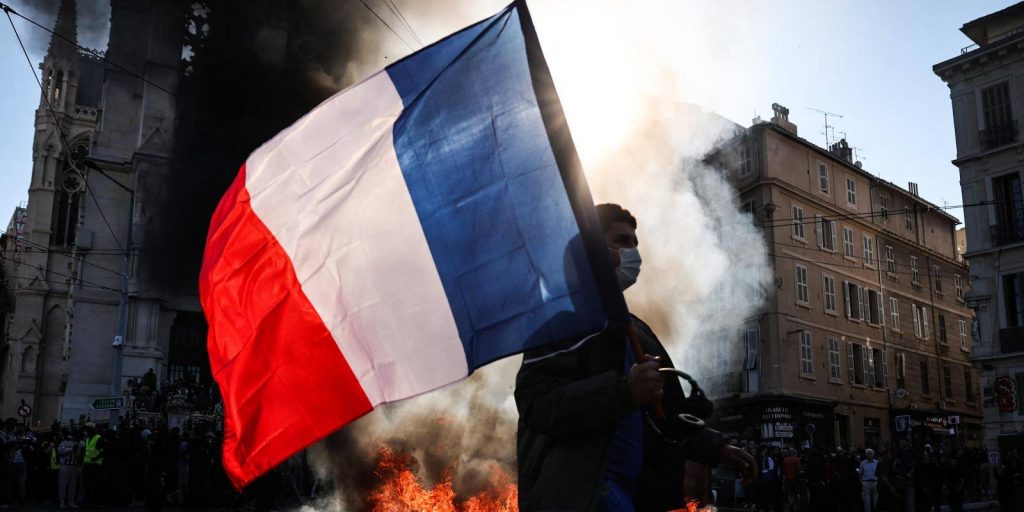
With the unrest in France, I hear many saying, “This could happen in America! Beware!” While I appreciate the sentiment, I have reasons why I don’t think this will ever happen in America. It could possibly happen in Minnesota, New York, California, Michigan, or Oregon, but not America. The country as a whole, the vast majority, will never let this happen. I’ll explain.
World War II
In 1940, the French and British military had both resources and technology that far outmatched that of the German forces. Many advisers to Hitler repeatedly warned him to wait until he could match those countries in might. Hitler recognized something that even Prime Minister Chamberlain later recanted into agreement with. Hitler stood by and watched for the last several years as the French and British were passive. Their passivity moved into blind acceptance. Such blind acceptance moved into outrage at anyone in disagreement. Thus began the cancel culture of the 1930s.
Among the intelligentsia, Bertrand Russell, H.G. Wells, Aldous Huxley, among many others, building arms was a sign of malintent, a murderous nature, and neanderthal politics. Bertrand Russell brought an argument to the table that dated back to William Condorcet in which there could be no reason to attack a country that posed no threat. Russell stated,
“When disarmament is suggested, it is natural to imagine that foreign conquest would inevitably follow and would be accompanied by all the horrors that characterize warlike invasions. This is a mistake, as Denmark shows. Probably, if we had neither armaments nor Empire, foreign states would let us alone. If they did not, we should have to yield without fighting, and we should therefore not arouse their ferocity.”
Here you see such passivism being espoused by the “smartest” of their time. John Dewey said in 1922:
“If we succeed in really understanding each other, some way of cooperation for common ends can be found.”
Vietnam War
This concept continues through history when Communist military leader General Vo Nguyen Giap, who defeated the French in battle in 1954, and later commanded North Vietnamese forces against Americans, said,
“We are not strong enough to drive out a half-million American troops, but that wasn’t the goal.”
The goal was to break the will of the American government and people. They had watched American news and witnessed the rally against America being involved in war. They knew the resolve of the American people had weakened. Consequently, they capitalized on this for their victories.
Cold War
Again, in the Cold War, many elite, so-called, intelligentsia, criticized Reagan for quickly building arms and standing face to face with Gorbachev calling his bluff. Gorbachev was looking for that same passivist from the former Hollywood actor that Nguyen saw in America in the 1960s and Hitler saw in France in the 1930s. Reagan did not oblige. Following attack after attack on Reagan’s character and inability to lead this nation, along with predictions from the morally elite of nuclear war as a result of Reagan’s policies, the actual results were silencing. Reagan was right. Sowell puts it this way,
“The fact that the consequence of Reagan’s policy was the direct opposite of what the ‘arms race’ argument had predicted, that is, the consequence was the end of the Cold War, rather than the beginning of a nuclear war, has had as little effect on the prevailing vision [of the anointed] as other facts which directly contradict other premises of that vision.”
This beckons back to the idea by Thomas Sowell of different visions. Sowell wrote,
“The vision of the anointed is a vision of intellectual and moral elites being surrogate decision-makers, imposing an over-arching common purpose to supersede the disparate and conflicting individual purposes and individual decisions of the population at large. The power of the intelligentsia is demonstrated not only by their ability to create a general climate of opinion that strikes fear into those who oppose their agenda but also by their ability to create a climate of opinion which richly rewards those political leaders whose decisions are consonant with the vision of the intelligentsia.”
Conclusion
As we see here, such passivism not only espoused but required in order to be considered of the elite, lest you risk being ostracized, ridiculed, hated, or violently attacked, has been the modus operandi for such anointed leaders throughout history. These “geniuses” are who I have learned to ignore when it comes to issues of societal consequence. They present an idea, attack you with emotionally driven insults when you do not assimilate, the idea is tested and proven false, they shift the narrative to remove culpability, all the while, they bear no cost for being as wrong as they were, yet still dodge the cold fact they were wrong.
George Washington realized at one point he was leading a band of misfits. He was outnumbered, inferior in weapons and technology, and lacked any real experience among those he led. But he fought anyway. He eventually, after much ridicule, rallied troops to a very unlikely victory against the British Empire. He was the underdog. This is why we love a good underdog story. Because we were once the underdog.
We simply are not a country that lays down and takes whatever you send our direction. The vast majority of our country’s population does not embrace passivism. There are certainly areas that will embrace such infectious culture. But by and large, passivism will not take root throughout the majority of our country. We are not built like the British, French, or the Germans. We are American. We fight. We will fight for something and we will fight against something, but we will fight.
In short, this is why I believe America as a nation will never become France.
Stay Classy GP!
Grainger