

A Swing and a Miss
- Darby Saxbe’s Advice to Steven Bartlett
- Undiagnosed
- I Am Sowellian
- Capitalism Didn’t Create Human Nature
- What Identity is Not
I recently read a piece by a writer I enjoy and appreciate. Reading this piece caused curiosity towards ideas presented here, from my perspective. The following doesn’t necessarily indicate I’m right. Just that presently, these are my thoughts.
I recently read a piece by a writer I enjoy and appreciate. Reading this piece caused curiosity towards ideas presented here, from my perspective. The following doesn’t necessarily indicate I’m right. Just that presently, these are my thoughts.
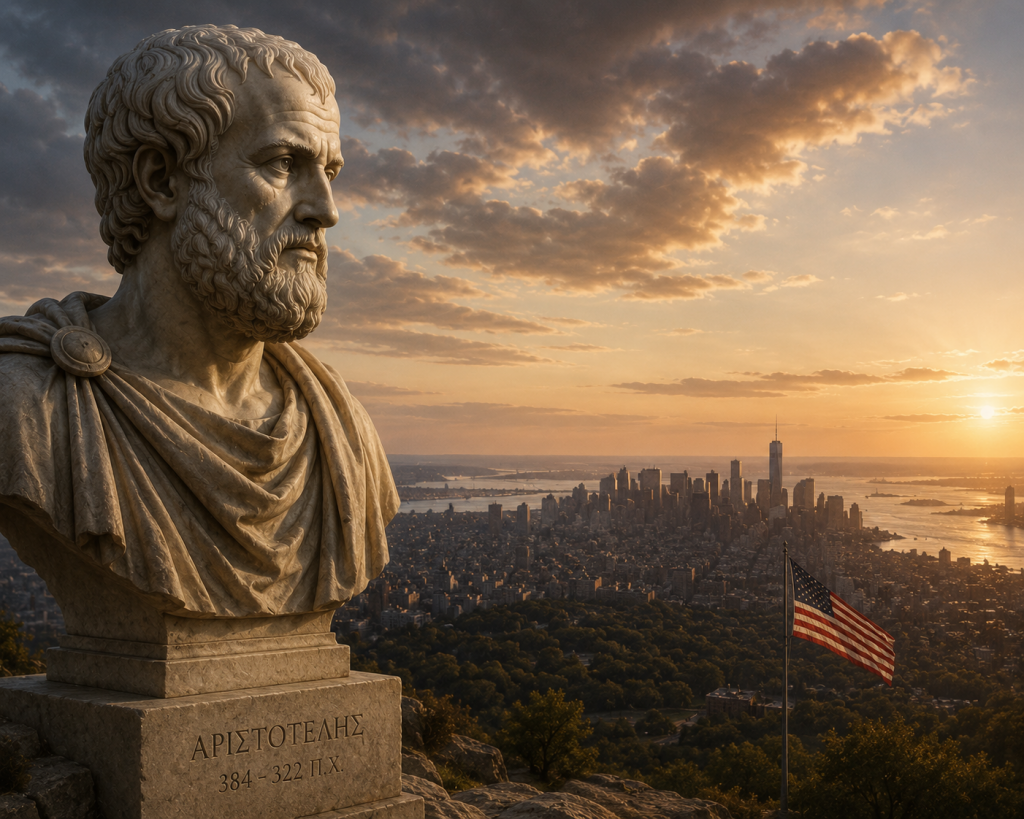
The piece was broken into six parts regarding Aristotle’s take on such subjects and how this may benefit us today: Rulers, education, family, middle class, freedom, and liberal vs conservative.
First, allow me to say I love ancient Greek philosophy. Learning Socrates, Plato, Aristotle, among others, has been a joy to undertake in my later years, as I did not appreciate this work early in life. These men set the stage for individualistic thought adopted by the Western world, ultimately leading to the formation of the greatest nation in the world.
Rulers
This is a subject in which I’ll be leaning on Thomas Sowell. It’s a matter of human nature and its potential.
“Leadership is a position of service; so our societal structures must be designed to bring the virtuous people forward and filter out those not suited.”
Aristotle was right to believe that leadership did not rest with just any citizen. After all, it was his teacher who said, “He who does not desire power is fit to hold it.”
Views of human nature with immeasurable potential tended to view institutions as systemic barriers, with little to no regard for individual decision being possible causation for the plight of one. It juxtaposes ideas of elite few possessing qualities and skills developed enough as to contain solutions to the world’s problems against human nature’s tendency towards greed, power, and tyranny given the unpunished opportunity.
“Aristotle argued that power should rest with the wisest and most virtuous citizens. They are the ones best suited to rule.”
Aristotle fully believed there were people capable of this. Possibly because he was one of such minds and surrounded by other like minds. The issue returns to tendencies and the cost of failure. Minds with ideas bear no cost of failure. It’s an experiment played out at the expense of others’ lives.
I simply do not hold human nature in such high esteem and would rather trust the collective experience of the average many who bear the cost of failure.
The government cannot and will not produce anything, only pervert what was meant for good. In this, Aristotle, in wanting monarchy, did not know what we know today.
Education
“I think Aristotle would approve of schools being funded by local taxes. Aristotle talked about the importance of private property and prioritizing one’s own community.”
I agree that it seems to be feasible to tax families to ensure basic education, as long as families have control over where this education comes from. It’s the monopoly of education that prevents actual progress in this field.
Family
“Tax breaks for families, maternity leave funded by the government, and universal preschool could build the culture that we ought to have.”
The concept of maternal leave funded by the government sounds great until “he who holds the purse, pulls the strings.” The government pays no price for being wrong or mismanaging other people’s money. But if they’re paying the bill, they’re also controlling the mechanism and rules by which it is carried out. And “universal” anything is a terrible idea. Again, when the government pays the bill, they make the rules. And I’m still in search for an example in which the government did something right.
Middle Class
“Rather than radical programs that react against social issues, how can we proactively build society so that the desirable outcomes naturally occur?”
At the societal level, this can only happen through incentive structures and trade-offs. It is worth noting that the middle class is “shrinking” because more people are gaining wealth, rather than the inverse. In fact, poverty is declining.
Freedom
Liberty can only be found within the confines of boundaries. Aristotle was on to something. Much like fire, if contained, it’s beautiful, warm, and beneficial. Untamed, it destroys everything it touches.
Liberal and Conservative
The wealthy paying more incentivizes them to leave to reinvest their money in a manner that best suits their enterprise. This is why overtaxing the rich never accomplishes what it sets out to achieve. Create tax structures that incentivize the company to create new jobs. In this, everyone wins.
Conclusion
Overall, when the government is involved, it ends badly. Every time. We definitely do not need their “help.” We need social incentives, created and maintained through traditions and evidence of efficacy. Restrict the malevolent to allow optimal economic mobilization, with full freedom of the individual to make choices that benefit him and his community. And leave the government completely out of it.
I love Aristotle’s contribution to western civilization. He is the father of science, as far as I’m concerned. He continued the great tradition of thinking critically. He provided ways of viewing nature, politics, ethics, in such a way that he is still on the front of our textbooks, essays, and minds to this day.
However, on governmental structures, for the most part, he missed. While polity was often championed by Aristotle, he was strongly in favor of monarchical structure, rule by few. Though he cannot be blamed. Societies learned over time that was a terrible way to govern. I firmly believe, because of his openness to ideas, he would embrace the concept of a representative democracy, republic, in which the consent of the governed is required.
Stay Classy GP!
Grainger