

The Unconstrained and Constrained Visions of Freedom and Justice
- Darby Saxbe’s Advice to Steven Bartlett
- Undiagnosed
- I Am Sowellian
- Capitalism Didn’t Create Human Nature
- What Identity is Not
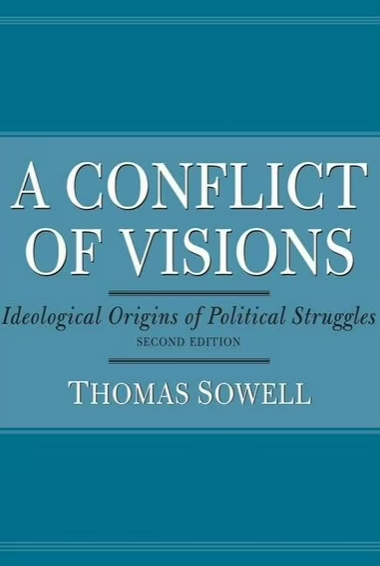
This a three-part series on “Conflict of Visions” by Thomas Sowell. It is split into the following categories of the way in which the unconstrained vision and the constrained view these subjects:
Part I: Human nature, Knowledge and Reason
Part II: Social Processes, Equality, Power
Part III: Freedom, Justice
In this conclusion to the series, freedom and justice are viewed quite differently, depending on who you’re asking. While these concepts seem axiomatic, as you are about to see, when viewed through the lens of the unconstrained and constrained visions, they appear to be very different Forms, as Plato might put it.
Freedom
In the unconstrained vision, individualism means to participate in the articulated decisions of collective entities while some with supreme wisdom possess exception from systemic or organized social restraints, like military service, or even laws.
Sowell articulated the constrained vision this way:
“Individualism means leaving the individual free to choose among the systematically generated opportunities, rewards, and penalties derived from other similarly free individuals without being subjected to articulated conclusions imposed by the power of organized entities such as government.”
According to the constrained vision, knowledge, wisdom, and virtue are derivations from the masses, and because so, the most an individual can expect is to be left free to choose among the various rewards and penalties emerging from systemic social processes without exemption from any of them.
Justice
Justice involves the attempt to change people’s motives, leaving incentives less important. This, according to the unconstrained vision, is an attempt towards a solution. Justice involves the mitigation of the breakdown of order. This, according to the constrained vision, is a trade-off because those in the constrained vision are aware of inherent human limitations.
To the unconstrained vision, justice is the conclusion of fairness and equality of results. Morality within justice is equal rights to the results. To the constrained vision, justice is the restriction on others to impede the process, making all processes equal. Morality within justice is equal rights to the process.
Conclusion
Both visions are concerned with social results. The limitations of man are at the heart of the theory of the constrained vision, while the potential of human nature is at the heart of the unconstrained vision.
The unconstrained vision seeks social results through collective decisions prescribing desired outcomes. The constrained vision believes it is beyond man’s capability to manage such vast knowledge and is dangerous to concentrate such power to make decisions, even if it were possible.
The unconstrained vision sees degrees of freedom as that which produce desired results. This is also true with justice through outcomes, power through control of one group over another, and equality being desired results having been achieved.
The constrained vision sees these entities quite differently. The characteristics of processes defined to restrict malevolent nature, whether it be freedom, justice, power, or equality, such processes have significance. A social process has freedom so far as it refrains from interfering with choices of individuals. A social process of justice ensures laws are just. A social process of equality means everyone abides by the same rules.
While results matter to the constrained vision, the general effectiveness of processes are the barometer for success and not measured by each individual result in isolation.
In the unconstrained vision, the moral and intellectual elite failing is preposterous and damning. To those with the constrained vision, failure is no surprise.
In the constrained vision, their adversaries are referred to as “well-meaning.” To the unconstrained vision, they are a “moral outrage.”
In the unconstrained vision, surrogate decision makers are best qualified to speak on our behalf. Such knowledge is consolidated. In the constrained vision, knowledge is inadequately possessed compared to knowledge systemically and collectively mobilized through free markets, values, and social processes. Thus the reason for restricting surrogate decisions makers’ power to rule over the discretion of others.
Thomas Sowell concluded his book by making this bold statement:
“While visions conflict, and arouse strong emotions in the process, merely ‘winning’ cannot be the ultimate goal of either the constrained or the unconstrained vision, however much that goal may preoccupy practical politicians. The moral impulse driving each vision cannot be jettisoned for the sake of winning, without making the victory meaningless.”
Sowell is calling for truth, compromise, and agreeing to disagree with the mass being represented in mind. Though there is a conflict of visions, there does not have to be a conflict of social prosperity.
Stay Classy GP!
Grainger