

The Unconstrained and Constrained Visions of Social Processes, Equality, and Power
- Darby Saxbe’s Advice to Steven Bartlett
- Undiagnosed
- I Am Sowellian
- Capitalism Didn’t Create Human Nature
- What Identity is Not
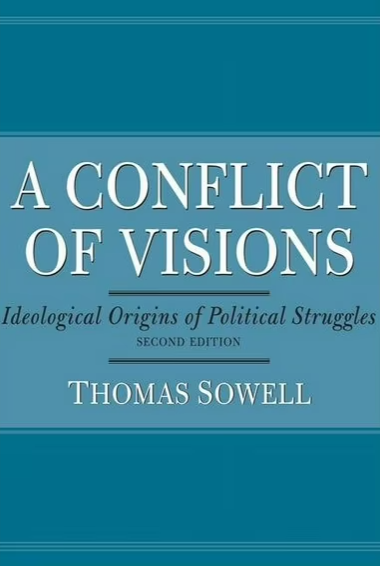
This a three-part series on “Conflict of Visions” by Thomas Sowell. It is split into the following categories of the way in which the unconstrained vision and the constrained view these subjects:
Part I: Human nature, Knowledge and Reason
Part II: Social Processes, Equality, Power
Part III: Freedom, Justice
As with anything else, most desire thriving among those close to them. To arrive there, agreement is often hard to find among those with differing views on how to arrive. Here, we see how the constrained and unconstrained visions differ in their view on social processes, equality, and power.
Social Processes
In the unconstrained vision, changes in human nature are the scenery itself, rather than just the costume. And only sweeping changes are deemed appropriate for the future. In the constrained vision, changes in human history are differences in costumes. It is the same fractured nature replaying itself in various new ways.
In the unconstrained vision, Loyalty, promises, patriotism, gratitude, precedent, oaths of fidelity, constitutions, marriage, social traditions, and international treaties are constrictions imposed earlier when knowledge was less, on options to be exercised later, when knowledge will be greater. In the constrained vision, true government requires more skill and experience than any one person can possess.
Comparisons between the morally and intellectually superior to the average person are commonplace in the unconstrained vision. The most outstanding individuals, intellectually or morally, are inherently limited in their capacity for knowledge in the constrained vision.
In the unconstrained vision, human nature is a variable, and variables can change. Obstacles to progress are to be overcome by the commitment, intelligence, and imagination of those who have grasped the possibilities open to society. Understanding human nature’s limitations is foundational to the constrained vision. Those in the constrained vision see outcomes as a function of incentives presented to individuals and conditions under which they interact in response to those incentives.
Best results should be sought directly in the unconstrained vision. When there are equality of results among those who have contributed, abstained, and hampered production, it strikes offense to the equality of process among those with the constrained vision. If a foot race is conducted under fair conditions, the result each time does not define justice in the constrained vision.
In the unconstrained vision, human capabilities permit social decisions to be made collectively through the articulated rationality of surrogate decision makers. In the constrained vision, decisions are to be made collectively through a composite of the average many, rather than the elite few.
What is justice and liberty, and how do we solve the issue of poverty? Here are the differences among the visions:
Unconstrained
- Justice– something is just or unjust based on the end results that occur.
- Liberty– results maximize scope of choice of individuals, often leading to advantages to those whose social backgrounds would handicap them in competition.
- Poverty– subsidize them to produce a more desirable result in the form of higher living.
Constrained
- Justice– adherence to agreed-upon rules.
- Liberty– freedom from coercion and arbitrary power of other men.
- Poverty– Provide incentives to succeed individually.
Equality
Attempts to equalize economic results leads to inequality in political power. Where achieving equal economic process limits centralized power because everyone must play by the same rules. Disagreement does not rely on degree of inequality, but what is to be equalized.
In the unconstrained vision, equality is achieved through results. Equality of opportunity means equalized probabilities of achieving given results. If the process given doesn’t produce equal results, then the process must be changed to maximize equal results for individuals. In the constrained vision, equality is achieved through process. As long as everyone is treated the same and operate under the same set of rules, the process is equal, resulting in equality having been achieved.
Those in the unconstrained vision believe some have little because others have much. There are finite resources. Those in the constrained vision believe consequences of decisions cause one to have little or much. Incentives drive this.
Equalizing material conditions of life are to be equalized under the influence of power of those with intellectual and moral superiority, according to the unconstrained vision. And according to the constrained vision, discretion is to be equally and individually exercised as often as possible under the boundaries of traditions and values derived from the widely shared experience of the many rather than special articulation of the few.
Power
To reduce the chances of war, in the eyes of the unconstrained vision, lean on the morally superior, communicate with enemies better, reduce arms seen as a threat to peace, and de-emphasize patriotism. To reduce the chances of war, in the eyes of the constrained vision, have military maximally prepared, promote patriotism, make adversaries aware of your military might, negotiate only when it can be done so without blackmail.
For crime, William Godwin said, “It is impossible that a man would perpetrate a crime in the moment when he sees it in all its enormity.” People are forced to commit crimes for specific reasons, poverty, discrimination, and unemployment. Therefore, reducing such reasons would reduce crime to those with the unconstrained vision. For crime, the constrained vision rests in the belief that it is axiomatic humans will be given to criminal nature.
Governmental Power?
- Unconstrained: Governmental power in economics: it is a matter of intentions.
- Constrained:Governmental power in economics: it is a matter of incentives.
In the unconstrained vision, power is to be seen as limited by intellectual elite through socially desirable results within man’s capabilities. In the constrained vision, power is to be seen as one reducing other’s options. It is not within man’s capabilities to monitor a myriad of individual results of behavior. Therefore, efforts must focus on restrictions of power, thereby restricting the ability of some to reduce other’s options.
Conclusion
Yet again, we see the pattern that both visions long for people among them to thrive in every possible avenue. The mechanisms of how and who decide distinguish the two visions.
For the next and last part, we will look a little closer at the ways in which the two visions disagree on freedom and justice.
Stay Classy GP!
Grainger