Excuse me for another pop-up post, but the newest events called for it.
If you weren’t aware of the absolute institutional ideological Marxist capture before this week, you’re aware now. It is nothing short of Cluster B-infused moral decay. But before we get too deep, let’s clarify.
Free Speech
I am a free speech advocate. I disagree with almost everything Harry Sisson ever says. But I will openly defend his right to say it. I believe people say hateful, hurtful, and harmful things on the internet. Hiding behind their keyboard shield like the snakes behind comedy and tragedy masks. But I fully believe in their right to say it. In fact, I want them to say it. So we can all see who the tyrants are. Who the psychopaths are. Who the Cluster-B RCT candidates are. I want you to speak so I know what is out there.
Thanks for reading Tidbits of Audacity! Subscribe for free to receive new posts every Tuesday.
Following the election of Trump, a shift began to take place. People all over the political spectrum were beginning to agree that the far left had gone too far. We had to find normalcy. Peaceful dialogue. Common sense. Biology needed to mean something, especially in sports. Merit meant something, especially in the workplace. With the assassination of Charlie Kirk, not only did that sentiment not soften, it just got louder.
L: Haley Kreidel— Nashville 911 emergency dispatcher; R: Laura Sosh-Lightsy— MTSU Assistant Dean
Death Celebration
There’s a zombie-style apocalypse of people celebrating the death of one man who stood for civil discourse without violence. Reread that sentence and let that sink in. As
It’s OK to murder you if you express opinions they disagree with and
You should not be able to own a gun to defend yourself against people who believe it’s OK to murder you for expressing opinions they disagree with.”
I did not agree with everything Kirk said, nor how he said it. But I agreed with the fact that we should have more civil discourse without violence.
I am not a fan of “cancel culture.” Never have been. Never will be. People should not lose their jobs over comments made. For years, people have been losing their jobs over saying something pro-American or pro-Western. For instance, schoolteacher Warren Smith conducted a Socratic thought experiment with a student. When he suggested that the student think through facts before assuming and claiming that J.K. Rowling was hateful, and after the student came to his own realization through, what counseling calls Motivational Interviewing, Smith was fired. This should have never happened.
Exceptions To the Rule
However, there are clear exceptions to this concept. One basic exception is economic. If you own a business or provide a product and speak in contradiction to your clientele, expect to be cancelled. Ask Tractor Supply, Harley-Davidson, or the Dixie Chicks. It’s simply not a good business move.
But maybe the more important example is professions where you are either a mind-molder or a life-saver. Educators, first responders, therapists, just to name a few. More recently, here’s a list of professionals who are mind-molders or life-savers and have been removed from their position:
Toledo fire and rescue firefighter, “Wish the guy was a better shot…”
Nashville 911 dispatcher
Assistant Dean of Students, Middle Tennessee State University (MTSU, where I am proud alum)
Teacher, Greenville County School District, South Carolina
Executive Assistant to Vice Chancellor of Development, University of Mississippi (Ole Miss)
Staffer at Ole Miss
Life-Savers
Now ask yourself, if your life was on the line, would you want to worry about dying due to a MAGA hat or Harris/Walz T-shirt? Think of it this way. A firefighter in Toledo rushes into a building, sees a man bleeding out and has the chance to save him. When he sees the MAGA hat, he thinks to himself, “One less scumbag.” Then “fails to stop the bleeding.” Comments about being happy a man died for his beliefs make it entirely plausible someone would do this on the job. Or how about the dispatcher in Nashville?
Dispatcher (D) 911, what’s your emergency?
Person (P) someone is trying to break into my house screaming something about my Trump flag on my porch!
D: Ok. Stay on the line and we will get someone there.
Then the dispatcher thinks, “Another MAGA down!” And simply doesn’t send anyone out but pretends she does. Or waits so long, the assailant enters and kills them.
Mind-Molders
The other side is mind-molders. I firmly believe that any educator who trains a person what to think, rather than how to think, should not be educating anyone. There is simply no place for that. This includes teaching someone that they should be republican, democrat, conservative, or liberal. Educators should not be teaching anyone that they should espouse these ideals, but rather that they should learn how to see all sides and explore these ideals. For instance, if you believe it was OK for Kirk to die because he was homophobic or transphobic, do you also feel this way about the Palestinians? Because they are very open concerning their stance on these issues. That is exploring all sides.
Or my industry— counselors, coaches, and therapists. I firmly believe if you say something publicly acknowledging the desire for another’s death, you should lose your license. How can you claim to care for people, advocate for people, and help people achieve stated goals if you are calling for the death of those you don’t agree with? It goes against every code of ethics in the industry. Which one’s you ask? Let’s look at a fellow Substacker’s comments— who happens to be a therapist.
Directly from the mouth of a therapist. Here are some codes she violated:
A.4.b. Personal Values. Counselors are aware of—and avoid imposing—their own values, attitudes, beliefs, and behaviors. A statement wishing death on someone clearly shows imposition of personal values, and is inconsistent with respect for client autonomy
A.4.a. Avoiding Harm. Counselors act to avoid harming their clients, trainees, and research participants and to minimize or to remedy unavoidable or unanticipated harm. Publicly calling for someone’s death is a form of speech that may create an unsafe, hostile, or discriminatory environment for clients with different views.
C.5. Nondiscrimination. Counselors do not condone or engage in discrimination against clients, students, or supervisees based on political affiliation, beliefs, or ideology.
NASW 6.04 Social and Political Action. She obliterated this one.
So yeah, I firmly agree with the investigations, unpaid leave, loss of license, and firing of these individuals that show little to no human decency. I don’t want this type of moral infection to be in mind-molders or to have an impact on life and death. Go be a politician. They say hateful things every day and no one cares.
Today, I agreed with people I rarely agree with. Kamala Harris, Bernie Sanders, Candace Owen, and many others. We all agreed that the attack on Kirk as senseless, unfathomable, vile, and evil. I even saw the statement, “Charlie Kirk and I have never agreed on one thing, except that everyone has the right to free speech and should not have to die for that.”
The shooting of Charlie Kirk has shaken the country and parts of the world. But you have to ask yourself why? People get shot all the time. And he was just a young, family man living the American dream. So why did this rattle the country and get polarizing political opponents all in agreement?
Because he was civil. Because he sought to have civil discord with those he disagreed with. Because he never once called for violence. Because he stood on convictions and could intelligently articulate them. Because he made the bold statement that the country cannot move forward until people who disagree have genuine, difficult conversations with the goal of understanding each other, in hopes we can find shared fundamental ideals to live our lives around.
Some want to be angry. And that’s a warranted response. “They hit us, we’ll hit back harder.” Unfortunately, Kirk would never have approved of that. He, like Dr. Martin Luther King, always declared to conduct peaceful interactions only. They both declared that violence was never the answer. So if not violence, then what should be my response? Well, first, I’m not about to tell you how to respond to a tragedy. But I will say the age of passive conviction is dead. The time for sitting back, wishing the psychopaths would pipe down and the problems would vanish, is over.
We’ve stepped into a new era. One that demands we give voice to our convictions. When something feels deeply wrong, silence is no longer an option. As the saying goes, “Well-behaved women rarely make history.” I’m not calling for misbehavior. I’m calling for courage. The kind of vocal, unflinching fortitude that protects values that you will defend.
What I Will Defend
I’ll defend my right to free speech. Along with that freedom comes the right to reject compelled speech. I will not be forced to call you anything I don’t want to. I will not be forced to call you a kitty cat because you feel like one today. I will not be forced to accept that you are using diagnoses as crutches to justify oppositional behavior. Especially in the counseling room.
I will defend ideas around biological sex.
I will defend family values and the obvious benefits that come with it.
I will defend men and boys.
I will defend girls, being that I’m a girl dad.
I will defend being a good person in every situation.
I will defend my right to carry.
I will defend integrity. Doing the right thing even when no one is watching and no one will find out.
I will defend ideas surrounding the benefits of religiosity. An upward aim at an ineffable telos. And my right to practice of such an aim.
I will defend a woman’s right not fear being around a man. That being around men should be the safest place for women to be. Therefore, men should work harder to be that guy.
I will defend stronger penalties for sexual offenders, particularly against children.
I will defend making the federal government smaller and smaller.
I will stand on convictions. And I will no longer be quiet. I will no longer sit back and hope things change. I will work to be the change I want to see. I will set this date as the day I defended values. The values that this country was built on: Faith, Freedom, and Families with strong men. Without apology. You can’t avoid being offended. And I won’t dance around your feelings. If your feelings get hurt, that’s your problem, not mine. If I belligerently set out to harm you, different story. Anyone that knows me knows that’s not my speed. But I’m not worried about your feelings anymore.
Defended Concern
I’m worried about the child that doesn’t know how to tie his shoes but somehow knows he was born in the wrong body, set up for castration because he has a mother with Cluster B-style FDIA. I’ll defend that.
I’m worried about the males that are told they are toxic just for being male, leading to committing suicide 4 times more than females. The ones that hear they are the problem. The ones that are targets of victim blaming. Like the ones who said it is Kirk’s “fault for being shot because he is so divisive” (This was on a major news network). I’ll defend that.
I’ll never sit on a train and watch a man stab a woman to death and do nothing. That man (really he’s a little child) in Charlotte would likely have been carried away in a zipped-up bag had I been on that train. Because I know the justice system won’t come through. I’ll defend that.
If Kirk’s shooter wanted to wake people up, he just did. Just not the people he hoped would wake. There are certain people in this world that I have never agreed with, not one sentence. But I will defend their right to say it.
Lastly, Kirk was right. He was right to be on a mission to get people in disagreement to talk. To sit, civilly, and discuss opposing ideas about how to achieve, what is mainly a shared goal: Human flourishing. But until we relearn the lost art of speaking with conviction without violence and without theatrical rage, brace yourself. That same gut-sinking feeling you had watching the Kirk video will sit on repeat, like a curse we refuse to break… #becausetribalism.
There is something that they all have in common, and it’s not just what you think.
September is Suicide Awareness Month. No better time to talk about such a horrific epidemic we find ourselves in. Before you bounce right out of here thinking this is going to be too heavy, I won’t go into those types of details. I intend to address a specific facet of suicide – creative people. Yeah you, Substacker, writer, visual artist, musical artist, culinary artist, you are who I’m talking about. I am who I’m talking about. To ignore our inclination toward suffering is to invite it to govern, rule, and ultimately destroy us from the shadows.
With the relatively recent suicide death of Anne Burrell, I began digging a bit deeper into literature that reflected the connection between creativity and an increased proclivity to suicidal ideation (SI). And what I found was, at the very least, alarming.
Culinary World
In the culinary world, it is a very fast-paced, high-stress, and at times, toxic environment in which to work. High demands are flying at them in a rapid-style fury. The consequences often include imposter syndrome – a feeling like they don’t belong because they’re not perfect. Such perfectionism undermines what joy the industry could bring. Additionally, intense environments, camaraderie masking dysfunction, long non-social hours, and high-pressure expectations in kitchens contribute to mental strain among highly creative chefs.
Notable Losses to Suicide in the Culinary World
Homaro Cantu: Chef, inventor, restaurateur
Anne Burrell: American chef and TV host
Anthony Bourdain: American chef and author
Entertainment
Then there is the entertainment industry, particularly the movie business. Acting requires deep understanding of other people. Deep levels of emotional empathy, experiencing emotions as if they are happening to you even when they are not. They are tasked to portray an array of emotions, attitudes, linguistic styles, physical attributes, and more. Often, what one finds in this industry is they spend so much time being someone else that they do not know who they are. This lack of identity often produces confusion. The industry also produces isolation because of being harassed by media and fans. Confusion with isolation is a lethal mixture.
Notable Losses to Suicide in the Entertainment Industry
Robin Williams
Margot Kidder
Dana Plato
Literary Landscape
Now to most of you reading this. Writers. You. Me. Writing involves a thought process that requires deep, intrinsic exploration. When you explore that deeply, you find things you forgot about. You find a mental box that was stashed away in hopes it would disappear, but it hasn’t. Writing also involves feeling another person’s depth of emotion. Writing displays this emotion, whether through a fictional expression, a self-help offering, or a liturgical grounding, with an aim to better the psyche through simplicity and ritual. The mind goes on an adventure, and the creative process fosters it in hopes it discovers some treasure trove of depth to unlock great mysteries that plague us.
Notable Losses to Suicide Among Writers
Ernest Hemingway
Yasunari Kawabata
Albert Camus
Pulitzer Prize winner Sylvia Plath (The “Sylvia Plath Effect” is a concept that poets are more susceptible than other creative writers.
(Please note that the first three are Nobel Literature Prize winners)
There’s one thing they all have in common, neuroticism. In psychology, the Big Five personality scale is the most widely used and cited as the most reliable method for understanding personality. The Big Five is comprised of Openness to experience, Conscientiousness, Extraversion, Agreeableness, and Neuroticism (OCEAN). Standard knowledge within this discipline will tell you that on average, conscientiousness is an excellent predictor of success, agreeableness can have positive correlations with anxiety, and women score higher in all five personality traits, including neuroticism. But what does that have to do with creativity?
Research on Creativity and Neuroticism
(Peters et al., 2018) Neuroticism not only increases suicidal ideation (SI), it also significantly increases actual suicide. This same study found that men are particularly at greater risk of SI if they are unmarried, recently unemployed, or recently divorced.
(Brezo et al., 2006) Neuroticism and openness to experience showed elevated risk of suicide. More specifically, extraversion had the strongest negative correlation to suicide and social introversion had the strongest positive correlation to suicide.
(Blüml et al., 2013) Neuroticism and openness to experience showed elevated risk for suicide, especially in females. In males, extraversion and conscientiousness were significant protective factors against suicide.
(Preti et al., 2001) People involved in creative professions have suicide rates three times higher than those in other professions. As far as the three domains mentioned here, in a study reviewing suicides, 84% of the total suicides in creative professions were literary professionals.
To be clear, Correlation ≠ Causation. There is not a guarantee of someone creative having high levels of neuroticism. Also, neuroticism doesn’t reliably predict creative achievement, but highly creative people often score high in neuroticism. Creative individuals, particularly in artistic fields like writing, acting, music, and culinary arts, frequently score high on neuroticism, especially when combined with high openness to experience, which is a reliable predictor of creativity.
While neuroticism alone does not predict who will become a successful artist, writer, or chef, creative people, especially those who channel personal emotion into their work, tend to be more neurotic than average. This is the conundrum for people like us. Creativity often arises not despite emotional instability, but because of it.
Where Do We Go From Here?
So what do we do about it? If I know someone is going to push me, I can brace for it and find ways to lessen the impact, hoping I don’t fall. Knowing that we are prone to this is a good step toward mitigating the effects. Think of fire. If I walked into your living room and set a fire on your coffee table, you would not be very happy about that. But if I walked about eight feet over and started one in the fireplace, you’d be fine with it. Why? Because it’s contained.
If we learn to control the force of our creativity, guiding it rather than becoming enslaved by it, we discover its true brilliance. Creativity, when unbounded, can blaze out of control like a wildfire, consuming without discernment; yet, when given structure, direction, and purpose, it becomes illumination rather than destruction. To harness creativity is not to diminish it, but to transform it into an ally. One that uplifts, builds, and heals. In this way, we honor the gift without surrendering ourselves to its tyranny. We partake in its radiance while refusing to be undone by its flames.
This comes through calibration. Community. Conversation. The antithesis of isolation. Isolation leads to being on the lists above. Please, for all that is beautiful, do not let your creativity be the very thing that annihilates your potential to better the world around you with your gift. Guess what? I hoped you gained something from this, but I wrote that entire piece to me.
Stay Classy GP!
Grainger
References
Blüml, V., Kapusta, N. D., Doering, S., Brähler, E., Wagner, B., & Kersting, A. (2013). Personality factors and suicide risk in a representative sample of the German general population. PloS One, 8(10), e76646. https://doi.org/10.1371/journal.pone.0076646
Brezo, J., Paris, J., & Turecki, G. (2006). Personality traits as correlates of suicidal ideation, suicide attempts, and suicide completions: a systematic review. Acta Psychiatrica Scandinavica, 113(3), 180–206. https://doi.org/10.1111/j.1600-0447.2005.00702.x
Peters, E. M., John, A., Bowen, R., Baetz, M., & Balbuena, L. (2018). Neuroticism and suicide in a general population cohort: results from the UK Biobank Project. BJPsych Open, 4(2), 62–68. https://doi.org/10.1192/bjo.2017.12
The is a free publication. But if you really enjoyed this post and want to support our work, I would enjoy a good coffee after writing an article. Thanks!
A Psychological Look at Unknown Number: The High School Catfish
The High School Catfish
Spoiler Alert! We are about to give away the end of the documentary in the first paragraph. If you don’t want to know the end, save this article, go watch it, then come back.
Netflix’s Unknown Number: The High School Catfish left me unsettled. The case was already disturbing enough. A teenage girl being harassed for over a year through anonymous texts and messages. But the real gut punch came with the reveal: it wasn’t a jealous classmate, or an online predator. It was her own mother.
That’s the kind of twist that makes us stop and ask: what could possibly drive a parent to do this? As a counselor, I naturally look at these stories through the DSM lens. And while no diagnosis from afar can ever be definitive, there are some clear psychological patterns worth unpacking.
A Digital Twist on FDIA
The closest clinical category here is Factitious Disorder Imposed on Another (FDIA). We used to call it Munchausen by proxy. Typically, it shows up when a caregiver fabricates or induces medical illness in someone they’re caring for, often a child, to maintain attention, sympathy, or control.
Kendra Licari didn’t fake medical symptoms, but she created a crisis nonetheless. By bombarding her daughter with anonymous harassment, she generated a problem that only she could later “help” solve. The dynamic is eerily similar: the parent manufactures suffering in order to keep the child dependent. This unmistakably produced severe distress in her daughter. Only this time, it’s Cyber-FDIA.
But FDIA alone doesn’t quite capture the full picture. The content of the messages, sexually explicit, cruel, sometimes telling her daughter to kill herself, suggests something more than just attention-seeking or misguided protection.
The Dark Triad Running the Show
To really understand this case, I think we need to look beyond disorders and into personality traits—specifically the Dark Triad: narcissism, Machiavellianism, and psychopathy (Note that I am aware of the new Dark Tetrad, but sadism did not fit here).
Vulnerable Narcissism: This isn’t the loud, arrogant narcissism we often picture. Vulnerable narcissism is fragile and hypersensitive, desperate for affirmation and terrified of abandonment. In Licari’s case, her actions look less like ego inflation and more like a desperate attempt to keep her daughter tethered to her at all costs.
Machiavellianism: The manipulation was elaborate and calculated. Hundreds of messages. Fake accounts. Careful concealment. That’s classic Machiavellian strategy: long-term deceit in the service of control.
Psychopathy: What stood out most to me was the callousness. Watching her daughter spiral under the weight of harassment, and not stopping, reflects an alarming lack of empathy. Refusing to take full responsibility for her actions was another indicator of psychopathy. Even if she wouldn’t meet criteria for full-blown psychopathy, the trait was alive and active.
With the statement, “Everybody has broken some law in their life. Nobody is perfect”, she made the Dark Triad evident. In this case, the Dark Triad wasn’t just present, it was driving the bus.
Trauma and the Distorted Logic of Protection
Licari later shared that she had been raped as a teenager. She framed her harassment toward her daughter as a twisted form of “protection,” suggesting she created a problem that would keep her daughter close, safe, and coming to her for help. In her mind, maybe she was shielding her daughter from the very dangers she had endured.
But here’s the truth, trauma might explain why her fears were so heightened, but it does not excuse or fully explain her actions. Many people endure sexual trauma, often at the hands of someone close to them. Almost none go on to send their own child sexually explicit messages, attempt to ruin their life, or tell them to kill themselves.
This went deeper than “I got raped.” Trauma may have been the seed, but pathology was the soil it grew in.
The Perfect Storm
At the same time, Licari was losing her job, suppressing her own trauma, and avoiding accountability. That combination created fertile ground for character flaws to take over. Without reflection, accountability, or support, trauma can metastasize. Stress, loss of identity, and secrecy cracked the door open, and the Dark Triad walked right in.
This is the part I can’t stop thinking about. It wasn’t just trauma. It was trauma + personality traits + a lack of accountability and boundaries. That’s when fear of losing a child morphs into controlling them, destroying them, just to keep them “safe.”
Why This Case Is Different
We all know parents who are overprotective. Many of us have seen trauma survivors carry their fears into their parenting. But this case is different. This isn’t the natural endpoint of being “too protective.” It’s something darker.
That’s why the story rattles us so deeply. It takes something familiar. It’s the instinct to protect your child. Yet it twists it into something unrecognizable. The very bond Licari claimed to protect ended up destroyed. Or was it? The daughter’s reaction to the news almost presented “I figured it was her.” Much like the story of Rapunzel, even though the daughter knew, she couldn’t bring herself to accept what her mother had done.
Why It Matters
It would be easy to write this off as one woman’s madness. But I think it raises bigger questions:
How do trauma and personality pathology interact?
At what point does “protectiveness” become control?
And what safeguards, like family, friends, and community, might have stopped this spiral before it escalated?
In an age where technology makes it easier than ever to monitor, manipulate, and entangle those we love, these questions aren’t abstract. They matter for how we parent, how we relate, and how we check ourselves.
A Final Reflection
The irony is crushing. In trying to protect her daughter, Licari destroyed her. The very bond she wanted to preserve now lies in ruins. That’s the tragedy here. Love, once twisted into control, becomes indistinguishable from harm.
The lesson for the rest of us is simple, but not easy. Real protection never requires manipulation. Real closeness never has to be forced.
We must recognize the line between care and control, and have the courage to stop before we cross it.
For obvious (and unfortunate) reasons, I see many people who struggle with anxiety. I want to cover a couple of things about anxiety that hopefully with help.
Anxiety is a Good Thing
First, anxiety is a good thing. Yep. You read that correctly. It wasn’t a typo. Anxiety is a good thing. It drives us to focus on a difficult task ahead. That feeling you get when you are about to go on a first date (yes, the one where you feel like need to get to a bathroom fast)—anxiety. The feeling you get when you’re about to go on stage—anxiety. The feeling you get when you are about to a take a test—anxiety. All driving us to be our best.
Daily Anxiety
Next, there is daily anxiety. Worry that our neighbor is going to mow his grass onto my driveway. Worry that I may hit traffic on my way to work, knowing I can’t afford to be late again. This may surprise you, but the counseling/therapy industry has pathologized this. That really makes no sense, but it’s true. This is not a clinical issue. This is a Tuesday.
Social Anxiety
Then there’s social anxiety, which is the most common. Very possibly from being nursed by devices. We haven’t had to look up from them, so when it’s time to react in real time, where we can’t backspace or just hit “block”, we freeze. Social anxiety has a fairly simple fix. When you are in a social setting, find someone to talk to and immediately start asking them questions about themselves. People love talking about themselves. Also, self-consciousness and absolute misery are difficult to distinguish on a mental health questionnaire. So asking them questions takes the focus off of you, relieving your anxiety symptoms rather quickly.
Clinical Anxiety
Then there’s clinical anxiety. This is debilitating. You can’t go to the mailbox without fear. Going to a public place is almost out of the question. You can’t hold a job or a solid relationship because of your crippling anxiety. We often turn to Selective Serotonin Reuptake Inhibitors (SSRIs) to relieve us of this fear and anxiety. Here’s the problem. These medications do the job, but they trim your range of emotion and they rewire your brain to need them. This dependency is not healthy.
Possible Solutions
[This is not medical advice] I’m going to give you a method that I have used for every client that has expressed a desire to come off of SSRIs. And so far, we’re batting 1.000. It hasn’t missed. This regimen needs to be practiced every day for at least 21 days consecutively.
Circadian Rhythm: Wake up at the same time every day. This helps release neurochemicals into your brain that were being withheld because of the unpredictability. It doesn’t matter that much when you go to bed but wake up at the same time every day for at least 21 days consecutively.
Protein: Consume some form of protein within 30 minutes of waking. The protein is going to help absorb some of the release on insulin if an anxiety trigger hits, preventing a hypoglycemic reaction. It doesn’t even matter what type of protein. Just take some within 30 minutes of waking up.
Walking: Walk like you’re late for at least 30 minutes per day at least 3 days per week. This sends proper blood flow to the brain, which helps everything from anxiety to dementia.
Saffron: I use a saffron gummy that also has vitamin D in it (this can be found at Walmart as well). Head-to-head, Saffron has been shown to have similar effects of SSRIs, but without the restriction of range of emotion.1234
Omega 3: consuming some form of Omega 3 will help reduce blood pressure, brain development, help in managing depression, and help protect against cognitive decline.
Caution
So far, it’s working. There are obvious risks with this. Let me share a couple. First, your body may react differently to saffron. Highly rare, but possible. So pay attention to your body and act accordingly to what’s right for you.
Here’s the big one. The first 3 days of coming off of SSRIs will be very difficult. Be in a safe environment. Inform those closest to you that you are doing this. Be ready for an emotional rollercoaster for 2 or 3 days. For most, by the time you get to day 3, things start to lift. And by the end of the first week, you feel better than ever. Then it lifts from there. This is what I have seen in every client.
I hope this helps. Thanks as always for supporting my work.
Stay Classy GP! (← God’s People)
Grainger
References
1Saffron for depression: Noorbala, A. A., Akhondzadeh, S., Tahmacebi-Pour, N., & Jamshidi, A. H. (2005). Hydro-alcoholic extract of Crocus sativus L. versus fluoxetine in the treatment of mild to moderate depression: a double-blind, randomized pilot trial. Journal of ethnopharmacology, 97(2), 281–284. https://doi.org/10.1016/j.jep.2004.11.004
2Saffron for depression: Akhondzadeh Basti, A., Moshiri, E., Noorbala, A. A., Jamshidi, A. H., Abbasi, S. H., & Akhondzadeh, S. (2007). Comparison of petal of Crocus sativus L. and fluoxetine in the treatment of depressed outpatients: a pilot double-blind randomized trial. Progress in neuro-psychopharmacology & biological psychiatry, 31(2), 439–442. https://doi.org/10.1016/j.pnpbp.2006.11.010
3Saffron for MDD and GAD: Ghajar, A., Neishabouri, S. M., Velayati, N., Jahangard, L., Matinnia, N., Haghighi, M., Ghaleiha, A., Afarideh, M., Salimi, S., Meysamie, A., & Akhondzadeh, S. (2017). Crocus sativus L. versus Citalopram in the Treatment of Major Depressive Disorder with Anxious Distress: A Double-Blind, Controlled Clinical Trial. Pharmacopsychiatry, 50(4), 152–160. https://doi.org/10.1055/s-0042-116159
4Saffron for post partum depression: Kashani, L., Esalatmanesh, S., Saedi, N., Niroomand, N., Ebrahimi, M., Hosseinian, M., Forooghifar, T., Salimi, S., & Akhondzadeh, S. (2016). Comparison of Saffron versus Fluoxetine in Treatment of Mild to Moderate Postpartum Depression: A Double-Blind, Randomized Clinical Trial. Pharmacopsychiatry, 50 https://doi.org/10.1055/s-0042-115306
Some may notice that I’ll write about children, parenting, biblical issues, church issues, relationships, and some current events. But you may notice that I tend to lean towards and often revisit issues of men’s health. It’s not that men are more important than women, couples, and children. They’re not. It’s not that men are smarter or dumber than women. IQ levels have remained rather steadily similar across cultures and time. It’s because while the whole world is willing to talk about the help that women (rightly) need, such as areas of attempted suicide or breast cancer, no one is addressing the growing problems that plague men and boys. The conversation is very one-sided. I’m not asking for the side to switch, just to show both sides.
Awareness and Budget Comparisons
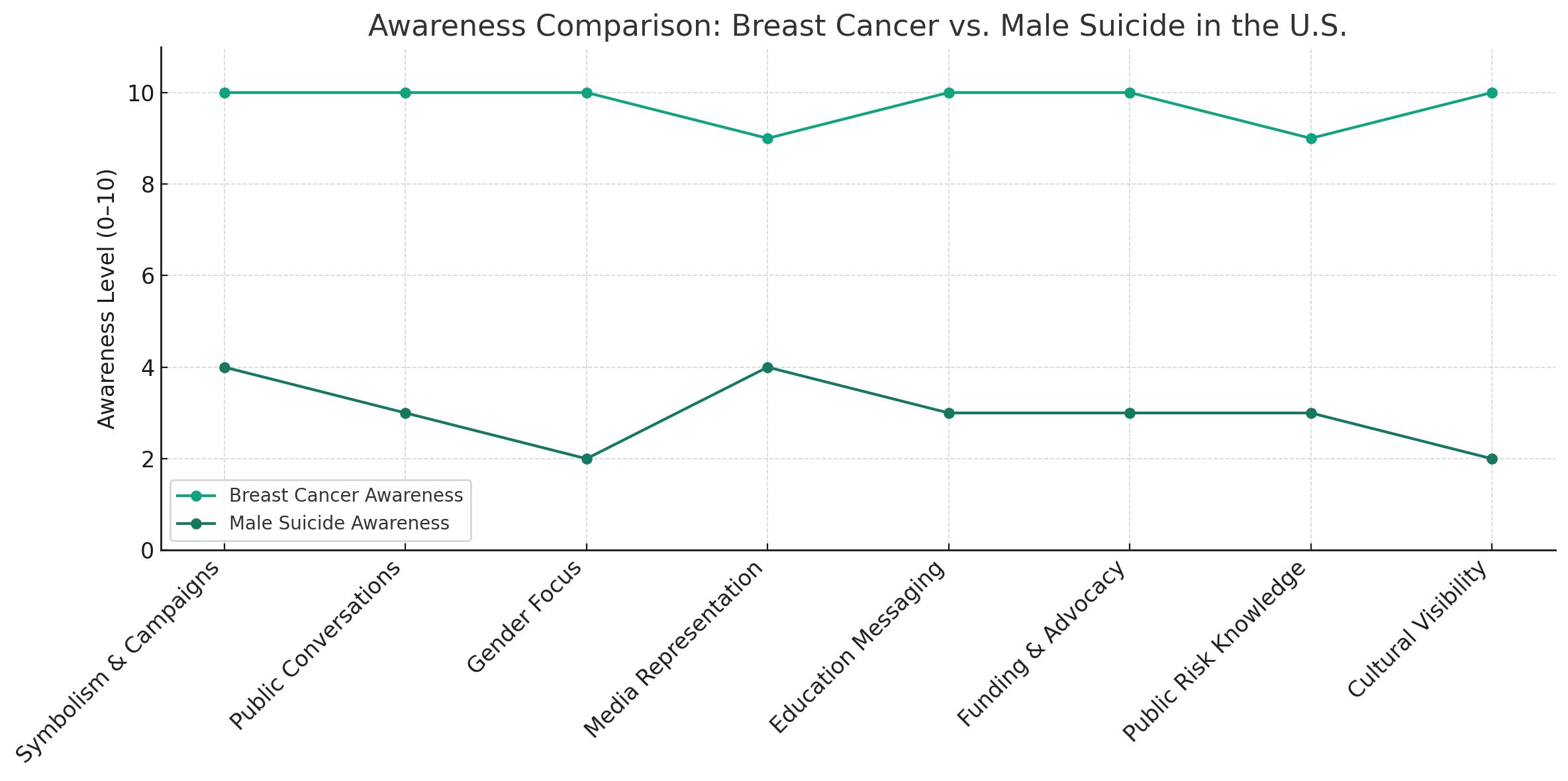
Take a look at breast cancer awareness vs. male suicide awareness:
Breast Cancer Awareness: Saturated, normalized, well-funded, and embraced by culture (I have two Breast cancer awareness bands on right now)
Male Suicide Awareness: Underrepresented, stigmatized, and critically lacking in broad public engagement.
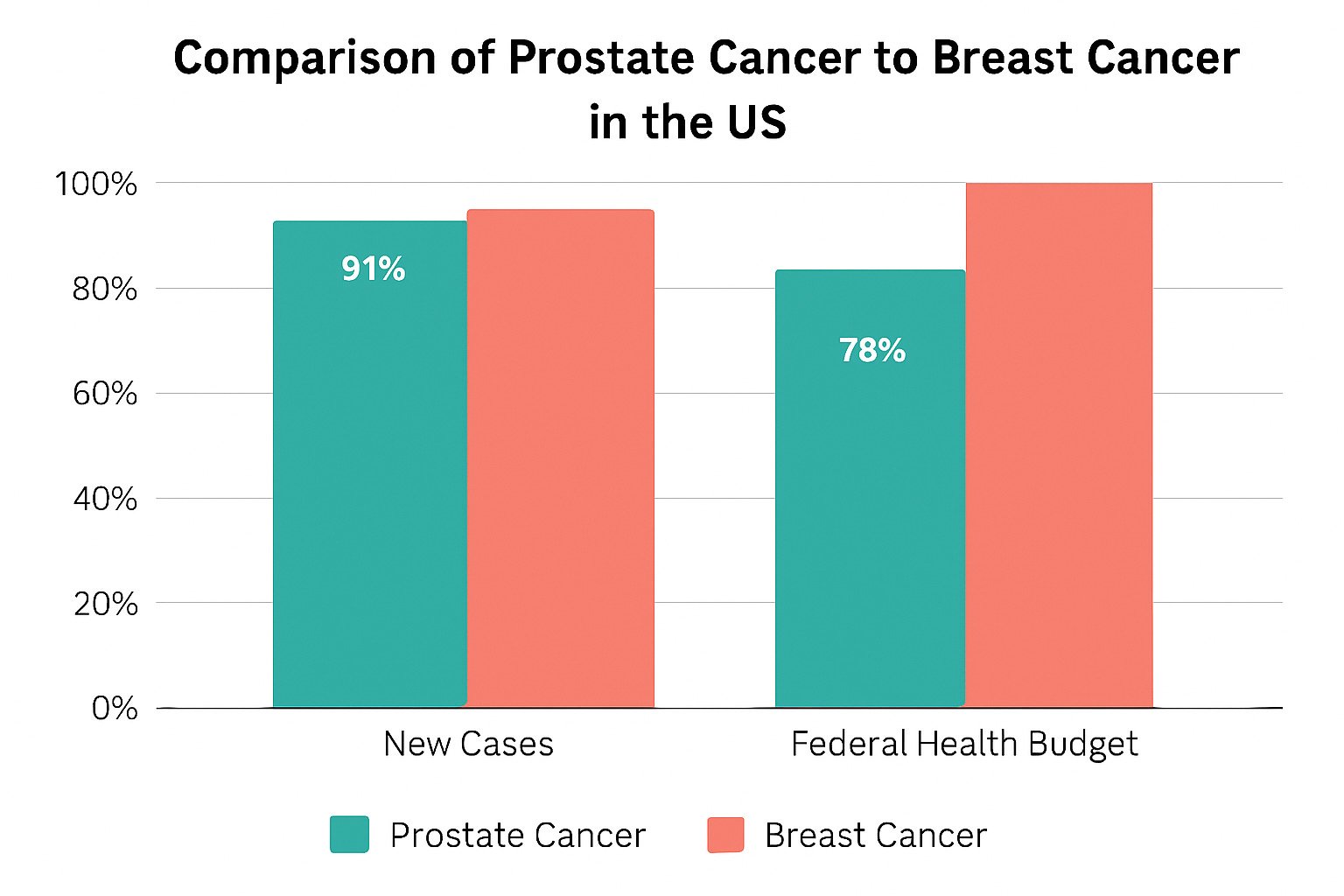
Or maybe we can look at how many new cases of breast cancer vs. new cases of prostate cancer there are each year, and the correlating federal health budget for each:
New cases: Prostate cancer new cases are about 91% of breast cancer new cases (255,395 vs. 279,731).
Federal health budget: Prostate cancer funding is roughly 78% of breast cancer funding ($319.8M vs. $410.5M).
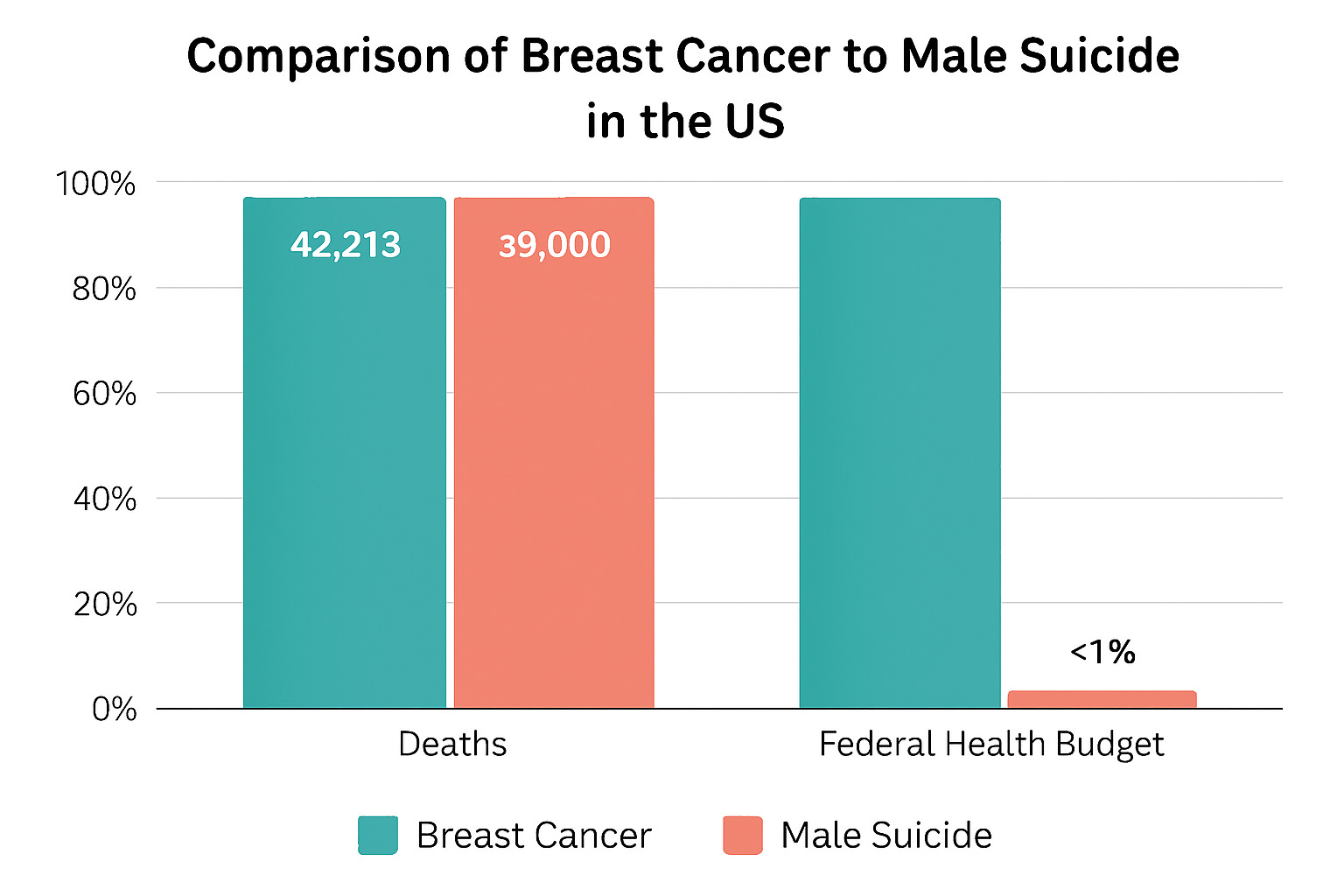
Or we could look at federal health budgets for breast cancer vs. male suicide. You’ll see that male suicide is 90% of the total deaths from breast cancer. But the budget for male suicide is < 1% of the budget for breast dancer. Dr. Richard Reeves might call that a Gap!
Any way you view it, it’s a problem. And many are rightfully calling it a crisis. Surely those in academia are seeing this and doing their part. Certainly they have an avenue to bring awareness to this issue and are willing to do so… right?
The Chance For Exposure
Ladies and Gents, step right up. I present to you Exhibit A! The reason I write about men and boys’ issues. I have had hope that the Association for Psychological Science (APS) wouldn’t be so ideologically captured. And for the most part, compared to the American Psychological Association (APA), they’re not. It’s rather difficult to be more ideologically captured than the APA. But here, with exhibit A, we see the blatant move to turn their heads and act like the elephant really isn’t so big. “Maybe if we just ignore it and pretend the elephant isn’t there, it will just go away.” Well, I’m sorry to report, it won’t, because of people like me.
The article is titled, “Science Counters Education Inequality.” In this article they cover educational gaps in society. They covered SES gaps, race gaps, and differences in STEM, reading, and math. They noted, “Women remain underrepresented in science, technology, engineering, and math (STEM) fields.” And even while highlighting math, they said, “They’re normally as skilled as boys or even better. The only issue is that they tend to be even better at reading even if they’re good in mathematics.” Every paragraph illuminated ways in which we should close gaps for girls and women. How we should be working towards girls advancing, and the issues that women face. They covered educational inequality—for females.
The Real Inequality
If you’ve read anything I’ve written, you already know where I’m going. They obviously ignored some keys points. They ignored that:
There is a hiring bias in favor of females in STEM.1
While there is a small gap in favor of boys in math, boys are an entire grade behind girls in English.2
Which gap is larger, a slight lead, or an entire grade behind?! They saw gaps in education among race, STEM, and SES, but outright refused to acknowledge the largest gap in the U.S. and the world in education, gender.
The gender gap in education is the largest of any other demographic comparison on earth. Boys are significantly behind in many areas. Possibly as a result of:
Feminized classrooms, calling boys who can’t sit still dysfunctional and in need of a diagnosis. Boys are wired to seek, risk, find adventure, and test boundaries. Sitting still simply isn’t what they are wired to do.
Maybe it’s because of a teacher bias in favor of females.3
Perhaps it is society’s paradoxical nature, condemning what it quietly perpetuates, insisting that boys suppress their struggles, “Figure it out” and “Get over it”, as if their pain were a nuisance rather than a need.
Regardless of the cause, the reality remains unmistakable: men and boys are in crisis. The evidence is undeniable. Yet when the APS was handed the chance to confront it, they turned their backs like cowards. As if moral responsibility were optional. As if truth itself could be banished by refusing to look at it. But truth doesn’t vanish; it waits, patient and unyielding, exposing the cowardice of those who pretend it’s not there. They had a moment to choose courage over comfort, and they chose comfort. I shouldn’t be surprised by their retreat. But it’s possible the lingering surprise is proof I still expect more from those who claim to seek truth. They didn’t just miss the mark, they threw the target in the trash. If Dr. Richard V Reeves were there, he’d be white-knuckled and asking what on earth they were thinking. Scratch that, he wouldn’t have to ask. We both know they saw the opportunity, recognized it for exactly what it was, and still, intentionally decided to parade out Exhibit A in willful blindness.
I guess they believe if they just go ostrich-style, we will just shut up. Well, they severely underestimated my stubbornness.
Stay Classy GP!
Grainger
References
1 Honeycutt, N., Careem, A., Lewis, N. A., Jr., & Jussim, L. (2020, August 18). Are STEM Faculty Biased Against Female Applicants? A Robust Replication and Extension of Moss-Racusin and Colleagues (2012). https://doi.org/10.31234/osf.io/ezp6d
2 Reardon, S. F., Fahle, E. M., Kalogrides, D., Podolsky, A., & Zárate, R. C. (2019). Gender achievement gaps in U.S. school districts. American Educational Research Journal, 56(6), 2474–2508. https://doi.org/10.3102/0002831219843824
3 Terrier, C., & Terrier, C. (2020). Boys lag behind: How teachers’ gender biases affect student achievement. Economics of Education Review, 77, 101981. https://doi.org/10.1016/j.econedurev.2020.101981
Seven Clues the Counseling Industry Has Lost Its Mind
I’m playing basketball when the referee makes the worst call I’d ever seen. This particular ref was known for being terrible. I just shrugged and began calling out our next defensive formation. The ref gave me a technical foul (this is bad in basketball). While that ref had a reputation for being terrible, I had a bit of a reputation too, for being a hot head. This led me down a path to consider what basketball would be like if the refs weren’t terrible. So guess what I did. Yep, I became a ref. And 18 years later, I don’t regret it. I’ve been able to referee high school, college, and minor league pro basketball all over the country. And I love it. But I got into it because of the severe deficits I saw and hoped to become good at it in order to pave the way for other younger refs coming in.
I still ref, but that’s a side hustle. It’s my “self-care.” I’m primarily a counselor. And one of the primary reasons I got in was because of the deficits I saw in the industry. There were so many incongruencies I could see from my everyday experiences that I had to get in and figure out what was going on.
Here are seven things I’ve noticed that have gone wrong in counseling, along with my advice to professionals about how to put them right:
Over-emotionality
Assuming there’s a diagnosis
The client is viewed as an annuity
Validation at all costs
Rumination
Weather Man Syndrome
Feminization
1. Over-Emotionality
The counseling industry has overemphasized the need for feeling. I’m not negating the validity of feelings. I’m suggesting that when making decisions, feelings are the last thing that should enter your mind. Rationality, practicality, who all these decisions will affect, these need to enter your mind. How you feel can help guide at times, but feelings alone are a terrible decision maker. If you make a decision based on a feeling, when the feeling changes, the decision changes with it. This explains why people who get married because of passionate desires get divorced fairly early in their marriage. They married because of a feeling. Then when that changed, their decision to be married did too. Anyone who has been married for any amount of time knows that the early feelings of infatuation in marriage go away relatively quickly.
How It Should Be
Acknowledge and address feelings. The counselor should give them their proper weight. Feelings detect, guide, and lead us to dangers to be aware of as well as opportunities to take advantage of. A counselor should hold that in juxtaposition with rationality and allow the client to experience this new perspective.
2. Assuming diagnosis
It is obvious that certain fashionable conditions are over-diagnosed (and drugs are over-prescribed for them). I’m not making light of these conditions, and I’m not suggesting they don’t exist. I’m suggesting that 14% of all boys in America between the ages of 5-17 do not ALL have ADHD. How is this diagnosis up from 9% just recently in 2015? Because it’s not actually true that more boys than ever have ADHD.
Boys are wired to run, risk, explore, and seek adventure, more so than girls. Boys are more physically active during recess: 22% as opposed to 10% for girls. And because we don’t know what to do with that, we pathologize it for 3 reasons:
That makes the parent not feel so bad about their kid
It helps the teacher out because she doesn’t know what to do either
Someone receives a kickback from big pharma for recommending medication.
How It Should Be
Not everyone needs a diagnosis. It’s ok to be rambunctious, and rambunctious kids don’t need to be labeled “too hyper.” You can be socially awkward and not be labeled neurodivergent. Then there are the iatrogenic effects of diagnoses; when the act of diagnosis or treatment causes “the condition” itself. We give these kids a diagnosis, they realize they’re “not normal”, and the rumination begins. This causes more problems than the original symptom they came in with. I’ve seen it. It’s devastating. And medication should only enter the conversation as a last resort, not a first option.
3. The client is viewed as an annuity
Too many counselors are seeing too many clients for way too long. I realize that not everyone can benefit from Solution Focused Brief Therapy (SFBT), but many can. Here’s the problem—this doesn’t pay for that trip to Cabo. It only pays for a trip to Costco. I know counselors who are seeing clients who have been with them for more than 2 years. This should be rare, but it’s not.
How It Should Be
I have yet to achieve this, but my goal is to be able to tell a client on the first session approximately how many sessions this will take to achieve their stated goals, with relatively good accuracy. Clients need an end game. They need to know hope is around the corner. Bringing them in for more than a year for the same issue doesn’t provide hope. It provides the practitioner enough money for an all-inclusive vacation.
4. Validation at all costs
This one is prevalent. Counselors are encouraged to validate at all costs. The client comes in and says her family doesn’t accept her because she now identifies as a kitty cat. We are now to validate her feelings as rational, sane, and beneficial to her overall health. Nope. I can’t. I won’t be mean. I won’t be overly contrarian either. But I won’t be telling that client that her “identity” is normal and that everyone around her is nuts. Not happening.
How It Should Be
If you are my client, what I will validate is that you are hurting. I will acknowledge the confusion you must be experiencing. I will help figure out where the confusion started and provide scientific evidence for why this confusion doesn’t have to debilitate you, then help you recognize it and begin to reframe your mentality. Counselors should not be validating falsehoods for the sake of the client’s feelings.
5. Rumination
At times, a counselor will let a client ramble on about all their problems without any direction towards healing. This is not therapy. This is rumination. Problems need to be dealt with in a structured environment to move towards healing; endless rambling about problems is not healing. The client doesn’t even realize this is happening. They just come in thinking, “I’m supposed to talk about my problems, so here I go.” And the counselor just lets them deliver unfettered rumination.
How It Should Be
It is the job of the counselor to be the professional. The counselor needs to interject when discussion turns into self-indulgent rumination. This can be done without confrontation. We just turn our focus to a point the client just made. We zero in on something he said that will lead us to a core cause, and that helps us address the symptoms. Move towards healing. Not rumination.
6. Weather Man Syndrome
Counseling has become prey to Weather Man Syndrome. I can be wrong about everything I tell you and there’s little to no consequence for me. Misguided counselors end up like the proverbial weather man who gets it wrong at least half the time while everyone still treats him as an accurate authority. Iatrogenic effects are as prevalent in mental health as they are in physical health. But there are warning labels on pill bottles. Counselors don’t come with those. We call it “informed consent”, but that’s not a real warning. We as counselors can do some real damage and so many are out there just throwing noodles against the wall hoping they make enough money to afford their favorite Airbnb this fall.
How It Should Be
There should be clear warnings of the possible side effects of receiving mental health counseling/therapy. Digging up old feelings is dangerous for some. We must be careful. Talk about this up front.
7. Feminization
I could write an entire article about this alone. I’ll just say this; we have gotten to a place where the normative experience for clients is a totally feminized one. This approach alienates half of the couples who walk into our offices, particuarly for couples counseling. The wife feels great about this. The husband looks at his watch every 5 minutes hoping we get out of there before the game starts. Why?
Women communicate to relate.
Men communicate to exchange information.
Women process negative emotion face to face through social communicative relation.
Men process negative emotion side by side through action and honor, allowing them the time to form the words needed to communicate the necessary information. A man will hear bad news and go fix a lawn mower he will never use and can’t actually be fixed.
So when a couple comes in and is expected to relate face to face, it shouldn’t come as a surprise when it doesn’t work for the man. There’s more to therapy than talking face to face.
How It Should Be
When I see men, I get them to do activities with me. We throw darts, putt on green strips in the office, maybe go outside and throw football. Then they open up. We must make counseling spaces inviting for men if we expect them to begin speaking to counselors about their problems.
Conclusion
Therapy doesn’t have to be stigmatized and it doesn’t have to be experienced as distressing. For individuals who have had unsatisfactory therapeutic experiences, I encourage continued engagement with other clinicians. Maybe you haven’t found the right therapist; maybe there are more competent practitioners who are more effective. There are others like me who are willing to address patient needs with cognitive empathy, constructive challenge, evidence-based science, and common sense. The tiny handful of us still willing to say out loud that there are only two sexes get slapped with the “iconoclast” label. Fine. Say what you will. But I won’t pander or lie to clients, and neither will any professional worth the title.
Grainger holds a B.S. in Psychology and is currently earning his Master’s in Clinical Mental Health Counseling at Liberty University. He’s an active men’s ministry leader and pastoral counselor with over 5 years of experience, currently seeing clients in both faith-based and clinical settings.
Karina holds a Master’s degree in Behavioral Science with concentrations in mental health, counseling, marriage and family therapy, career development, and child and adolescent therapy. She has a robust research background and is board-certified in brain health, ADHD, sensory processing, and wellness. She, too, actively sees clients in clinical practice.
Together, we represent both the psychological and pastoral lenses on today’s mental health landscape. We are deeply committed to truth over trend, accountability over blame, and growth over grievance. In this article, we explore how communism has historically undermined the structure and values of the American family. Combining historical evidence with lived experience, Karina’s firsthand memories of life under communism and Jason’s work as a counselor, we expose how communist ideology weakens faith, parental authority, and generational bonds. Our shared commitment to protecting the American family drives this important conversation.
What you are about to read is Grainger’s reflection on the historical agenda to dismantle the family, paired with Karina’s lived testimony of the very communism some in Gen Z now idealize; an ideology that seeks to unravel the foundational merits of the family.
Grainger
I’ll get right to it. No fluff. The attack on the family isn’t new. And it isn’t accidental. It was intentional, particularly by proponents of communism.
Even before the Communist Manifesto, Robert Owen, founder of the “Yankee Utopians”, wrote that the absurdity of religion and marriage, founded on individual property, were total monstrosities.1 Karl Marx and Friedrich Engels often wrote about the destruction, dissolution, and abolition of the family. Marx once wrote,
“The hallowed correlation of parent and child is disgusting.”
The Russian Orthodox Church had long prohibited divorce. But with the Bolshevik rise to power, that prohibition was eliminated, causing an explosion in divorce rates. The dismantling of the family opened the door for Lenin to implement his system of terror. Very early on, it was understood that marriage was the greatest impediment to implementing communism in any society.
Bolshevik theorist Aleksandra Kollontai wrote:
“But the joys of parenthood will not be taken away from those who are capable of appreciating them. That is, from those mothers and fathers who happily accept that the best educators are not the parents, but the collective, not the sanctuary of the home, but the supremacy of the state. The children would be reared by society. Children would be wards of the state.”
Margaret Sanger
Then there’s Margaret Sanger, who is not winning “Mother of the Year” anytime soon, according to her son, Grant. She is best known for her quiet campaign to eradicate the Black population. Critics twist her infamous line, “We do not want word to go out that we want to exterminate the Negro population” in an attempt to preserve the reputation of someone they call a hero. Unfortunately, in 1926, this hero went on to give a speech to the Klu Klux Klan in Silver Lake, New Jersey, likely repeating such rhetoric.
But who was she? Well, besides being an openly neglectful mother, she joyfully told her husband she would be sexually free whether he liked it or not. Such “freedom” was a movement championed by Emma Goldman, who was eventually deported by President Wilson. Margaret’s first of many affairs was with Goldman.
After destroying her marriage, she went on to destroy other marriages, having numerous affairs with men across Europe, including H. G. Wells, who was infatuated with the “Candid, fair, and honest Joseph Stalin.” Wells was also an admirer of Lenin.
When the racial eugenicist herself wrote a June 1935 article titled, “Birth Control in Russia”, this was the first clear indication of the ideological blueprint she wanted to embed in American consciousness. She originally began American Birth Control League, later renamed Planned Parenthood, to rid the earth of “Idiots, morons, imbeciles, and the mentally and physically defective.” What a Mother Teresa she was. Ironically, Sanger was startled by how many abortions were taking place in Russia. She was for eugenics and birth control, but not abortion so much. She eventually made the statement,
“A functioning Communistic society will ensure the happiness of every child and will assume the full responsibility for its welfare and education.”
There, she leaks her true intention of the child being property of the state.
But abortion had already spun out of control, to the point that Stalin himself, one of the deadliest men in world history, had to ban abortion after observing the catastrophic population decline. And Sanger’s mission to export this ideology to America was unwavering. The family, once a cornerstone of civilization, had become a liability to communism. The Communist Party of the Soviet Union had declared the family a “formidable stronghold of all the turpitudes of the old regime.”
Educational Infection
Ralph de Toledano, a historian who studied Columbia University’s interest in communism with comprehensive tenacity, wrote,
“The primary method [to wage warfare on Western civilization] would be to saturate Western culture with the miasma of unrestrained sex. The destruction of the West, from which a Marxist utopia would arise, was to be achieved through a mass brainwashing of neo-Marxism, wrapped up in what euphemistically became known as Critical Theory.”
Toledano identified the two greatest obstacles to a Marxist utopia are God and family.
The architects of Communism’s infiltration of the West declared the primary focus was the education system, getting naïve American parents to hand over their children to the universities for ideological reprogramming.
Kate Millett
Introducing Kate Millet, a student at Columbia University, where she earned her PhD and wrote her most famous book Sexual Politics. She grew up deeply troubled. She frequently had psychotic episodes that included several attempts to kill her sister, Mallory.
I’ll leave you with this enlightening bit of information. To show you where this issue really is, here is an excerpt from a gathering among university professors, led by Kate Millet, where she led a chilling chant. Millet’s sister, Mallory, detailed the following chant at an event she attended:
Kate Millet (KM): “Why are we here today?” the chairwoman asked.
Group (G): “To make revolution,” they answered.
(KM): “What kind of revolution?”
(G): “The Cultural Revolution,” they chanted.
(KM): “And how do we make Cultural Revolution?”
(G): “By destroying the American family!”
(KM): “How do we destroy the family?”
(G): “By destroying the American patriarch,” they cried exuberantly.
(KM): “And how do we destroy the American patriarch?” she probed.
(G): “By taking away his power!”
(KM): “How do we do that?”
(G): “By destroying monogamy!” they shouted.
(KM): “How can we destroy monogamy?”
(G): “By promoting promiscuity, eroticism, prostitution, abortion, and homosexuality!”
Columbia University’s Red Legacy
By the 1960s, Marxist ideology had a firm grip on universities, namely Columbia University, which is now no surprise. What did Columbia U produce?
Early faculty at Columbia was John Dewey, whose work was admired, praised, and eventually implemented by the Bolsheviks soviet education system.
2005: MEALAC controversy- professor and students accused of hostility to pro-Israel students, also anti-Israel bias and Jewish student intimidation uncovered
2007: Iranian president, while holding Holocaust denial and Israel’s right to exist, was asked to speak at Columbia.
2010: BDS. Ultimately there was no divestment but Jewish students reported feeling very unsafe, with no recorded response.
2016: pro-Palestinian events begin to increase. Posters everywhere comparing Israel to Nazi Germany. Student-wide call for intifada. Jewish students filed complaints regularly to no response from university,.
2023: after 10/7, intense protests began. Pro-Hamas vitriol filled the campus. Students set up Gaza solidarity encampment, pro Hamas students occupied buildings and refused to allow Jewish students in, increased violence, including property damage, physical altercations with police, assault on Jewish students, and even discovery of a swastika on campus.
The Effects of Marxism on the Family
Karina’s Experience Under Communism:
In the early 1950s, after the Bolsheviks had financially stripped the wealthy upper class (in the name of fairness and equality), they repurposed private homes and buildings to force people into communal living. The highest achievable honor became getting an apartment of your own. People applied and waited for years to receive one. Many, like my paternal grandparents, even married each other to secure an apartment that was pending approval for my grandmother, they did end up falling in love later.
I was born in the former Soviet Union in the early 1980s to a small Jewish family. My parents shared a 600-square-foot apartment with my father’s parents. We shared one bathroom and one kitchen, and the living space was communal. (This living arrangement was actually considered wealthy and upper class.) Most families had to share living spaces with strangers.
The Red Attack on Men
As Marxist ideology spread in the 1960s, patriarchy was cast as inherently evil, men as the root of all social ills, and the solution as simple, remove the man. This was fertile ground for implanting policies to ensure the demoralization of men.
Karina
For a man, life in the Soviet Union was bleak at best. Once school was over, the options for higher education, work, and the future were predesigned and prewritten for everyone. You only had 2–3 rational choices, and all of them required government micromanagement. No matter what you did, where you went, or how you lived, you were watched, managed, and “parented” by the government.
By nature, men are providers and protectors. Men have roles that ground a family system and support the healthy development of its members. But take away a man’s right to provide and protect, and all that’s left is misery. The only other option—what my father chose—was to fight the system and run. However, that risk carried deadly consequences, literally. Going against the government meant:
Joining the black market, which in our language was capitalism. The black market operated on a supply-and-demand system. Most of it was run by men, but my mother was involved too, as were several women at the time. Supplies were brought in from Poland and other nearby countries and sold privately.
Practicing religion—any religion. There was only one god, and it was the government.
Reading, listening to, or watching American music, movies, and books.
Denouncing the government in public.
Protecting children against the government run and managed school system.
What made life in the Soviet Union even more unbearable was the cognitive and emotional abuse, manipulation, and control of children. Once a child turned six and was sent to school for an education, the indoctrination began. Children were taught from first grade to build loyalty and unquestioning love toward the government—only the government. My mother was desperate to keep me home as long as she could, hoping we’d get our refugee papers before I started first grade. However, that didn’t happen, and she had to send me to school. Parents who quietly hated the Soviet Union dreaded the day school started for their children. No one was excited, no one was cheerful—it felt like going to a funeral. Children were taught to tattle on their parents if they heard any anti-communist conversations, spies in our own home. The entire school system was carefully developed to ensure complete compliance and order.
Do I look happy on my first day of 1st grade?
Should a 1st grader look that worried?Look at the other children
Karina’s Personal Experience:
My father couldn’t protect me. He understood that I was now the property of the communist party. Everyone knew, but the risk of change was so high most people just couldn’t handle the stress of planning asylum or a refuge.
Helplessness eats away at our will to live from the inside. In a communist, government-run society, men are ideologically minimized and almost completely controlled to ensure the survival of the country. They close their eyes, bow their heads, and walk into their own demise—dragging their families with them.
My grandfather, a loyal communist, pledged his entire life to the system. He barely worked, barely provided, and reported anyone he knew who was involved in the black market. That is, until his own son and daughter-in-law, my parents, got involved. My father paid him off to keep his mouth shut, and that was the very first time my grandfather felt the power of a tiny bit of freedom. Years later, he finally denounced communism—but not before ruining lives in the name of the idea that everyone should be equal, included, and judged.
Grainger:
There it is. The communistic utopia, manifest before our eyes.
Moynihan Report
It should come as no surprise that President Johnson implemented social programs that inadvertently incentivized single motherhood. But Daniel Patrick Moynihanwarned about the risks of government programs unintentionally undermining the family. In his report, he wrote that the emerging matriarchal structure developing in many low-income Black households could lead to further marginalization of men and generational dysfunction.
“A community that is centered on the female, with men increasingly in roleless positions, is likely to find it difficult to sustain stable family and community life.” — Moynihan Report, 1965
No one listened. The unintended consequence was that financial support became easier to access without a male partner present. The father became disposable. As of the 1965 release of the Moynihan report, 3% of white babies were born to single mothers and 23% of black babies were born to single mothers.2 This number, following this policy, jumped quickly to 8% for white babies and eventually, in 2023, was listed as 28% of white babies born to single mothers and 70% of black babies born to single mothers. This shows race was not a factor. It affected everyone.
Why the Father Matters
In one study, one significant finding was that youth living in fatherless homes have the highest levels of incarceration rates. However, youths in homes where only the father is present, there was no difference in the rate of incarceration than that of youth living in two parent homes.3
According to the U.S. Department of Health and Human Services, fatherless males are at a significantly greater risk of suicide, mental illness, and becoming a father as a teenager.4
Daughters of single parents without the father involved are:
The facts are sobering: The campaign to eliminate fathers in America, and thereby weaken the family, was not only strategic, but devastatingly effective. We are living in the aftermath of a carefully orchestrated ideological takeover.
We must decide whether we have the courage and the clarity to rebuild what was torn down, starting by rebuilding and prioritizing the family.
Karina’s Conclusion:
The minute socialism or communism enters a conversation, life as we know it begins to unravel. The core idea behind both—essentially two sides of the same coin—is to dismantle the most successful and natural system known to humanity: the family. Like animals and plants, people need a healthy structure to grow and evolve.
Communism wants to be your parent—that’s what it ultimately comes down to. It wants to raise you, control you, and keep you “safe.” It is the ultimate hungry and selfish parent: one that gives you life only to dominate you under the guise of protection.
That’s our 4 cents. Stay Classy GP!
Grainger & Karina
1 (All quotes and citations were from the following book, unless otherwise cited)
Kengor, P. (2015). Takedown (1st ed.). WND Books.
2 Moynihan, P. D. (1965). The case for national action: The negro family. U.S. Department of Labor
3 Harper, C. C., & McLanahan, S. S. (2004). Father absence and youth incarceration. Journal of Research on Adolescence, 14(3), 369-397. https://10.1111/j.1532-7795.2004.00079.x
4 Seidel, F. L. P. (2021). The proclivity of juvenile crime in fatherless homes: An urban perspective (Psy.D.).
Post-president legacies are a strange thing. By the time Reagan was out of office, he didn’t know who or where he was, mirroring Joe Biden’s experience. W. Bush backed out of the spotlight just long enough to return by forming friendships with Clinton and Obama in an attempt to show solidarity for a country they all love. Jimmy Carter had one of the best post-president legacies, offering his time for humanitarian causes. He was often mislead by his feelings to ignore facts, the same dysfunction that soured his presidency, but his efforts were driven towards peace and love for other human beings, causing him to be very loved by most Americans. As it turns out, Obama may go down as having the best post-president legacy in history, other than maybe George Washington.
I was not a fan of much of what Obama did (and did not do) in office. The entire time he was in office, I felt like he was regurgitating buzz words for the demographic party that further ensured division. The democratic party drew the hard line that “we’re over here and you stay over there”, and Obama seemed forced to fall in step. I didn’t get the sense that he was saying exactly what he wanted to say. He wasn’t promoting ideas he really believed needed to be emphasized. He was a champion for ideological dichotomy.
He always struck me as someone who was very common sense oriented, level-headed, and a deep thinker. But during his presidency, his actions, and often inaction, were very divisive, lacked evidence necessitating emphasis, and was void of issues that were important to most Americans. But they lined perfectly with every flyer posted by the democratic party and their super PAC donors.
What is Obama Up to Now?
Now he’s out of office and doing podcasts. The recent podcast with his wife and brother-in-law, Craig Robinson, came out and got mixed reactions. The first thing many Americans lamented was highlighting that he called for men to have gay friends so if their son comes out, he has someone to look to. In context: He was not highlighting sexual orientation. He was highlighting diversity in friend group. Don’t just have a bunch of guys in your circle that look and think exactly like you. Challenge each other and yourself. That was his point. But leave it to hardline conservatives to refuse to remove the side blinders and focus on what was not being focused on. Yes, the right can be ideological too.
Obama Talks About Men and Boys
The focus of this podcast was on young men. Right away—that’s new! Since when did someone care about boys and men? I am of the belief that Obama cared the entire time but was not allowed to address it, except the one time he did in a speech, and received backlash from his party. After their slap on Obama’s wrist, he never did it again. But listening to him here, it is clear this is something on his mind. It is also clear Michelle (Misha- as Craig called her) has read research and is equally as concerned about where boys are headed.
Other Criticisms
Some have criticized the podcast as them saying what needs to be fixed about boys so that it benefits girls. They have two daughters. What other perspective would you expect from girl-parents? I’m a girl dad and I thought the same thing. My daughters need good men to marry. But even that criticism has no merit. Obama literally said,
“We have spent so much time talking about what boys do wrong that we have failed to say what they did right.”
Obama’s Marriage
Obama covered the laughable rumors that their marriage is in peril. Michelle did openly state that there was one time during their long marriage when she thought it was about to end, but that they worked through it. She did not cover when that was. Obama shared openly that he did not know his father and was raised by a very young single mother who did her best but was ill equipped to raise a young man. So he knew the importance of having a good father and set out to be that for his daughters.
What They Really Got Wrong
There were at least three times when they (really Michelle) were way off in their approach to issues with young men and boys. They basically kept referring to boys’ natural tendencies, like risk, adventure, and aggression, as broken and how they needed to be more like girls. This is so incredibly false. You will not convince a dog to purr. It just doesn’t know how. At one point. Michelle made the statement,
“I think it’s time to look at stepping away from sports and looking towards the arts, theatre, music, to give them an outlet for their feelings.”
Wrong. It’s not that the arts are bad. They’re not. I was in the music industry for 15 years. It is a great outlet for expression and the people I became friends with were very good people. But stepping away from sports is a terrible idea. Sports brings out the best in boys and young men. Camaraderie, teamwork, adversity, resilience, all get built in sports. The only idea in this part of the conversation I liked was that boys and young men need to diversify their interests and find outlets for expression. That’s true.
With all of that, Obama did attempt to keep the focus on the idea that we are pathologizing boys and young men, rather than allowing or creating spaces where they will thrive. Michelle quoted Obama as saying that the education system in its entirety is feminized, having no space for boys to be boys. Thus, instead of allowing boy traits to shine, we pathologize them because they can’t adhere to guidelines of sitting still the same way girls can.
My Assessment
Overall, the theme was clear. Young boys and men are suffering. Whether its due to failed parental strategies of trying to make them be more like girls, or even a more systemic dysfunction of making all learning spaces feminine and wondering why boys are
“People are capable of having two thoughts at once.”
No one is calling for attention to women’s issues to end. Only that we open our focus to both males and females.
So I understand Dr. Richard Reeves’ enthusiasm for what Obama had to say in this podcast. I hope we hear Obama’s emphasis on boys needing a community of men, not just a good father, to steer them in the right direction. I believe that’s true. However, I also hope we stand firm against Michelle’s approach to feminize boys, as if that’s the path to true morality.
All in all, with Obama talking about issues among men and boys, which was most likely very important to him the entire time, having been raised without a father, if he keeps this up, he may go down as having the best post-POTUS presidency ever..
Stay Classy GP!
Grainger
1 Reardon, S. F., Fahle, E. M., Kalogrides, D., Podolsky, A., & Zárate, R. C. (2019). Gender achievement gaps in U.S. school districts. American Educational Research Journal, 56(6), 2474–2508. https://doi.org/10.3102/0002831219843824
I know that when I’m eating pizza, I’m not aware of when I’ve had enough. I just keep eating and eating. But usually around 2AM, my body tells me I had too much. Really inconvenient time to tell me this. So why do I eat to the point of hurting and not even realize it? Because I haven’t defined the number of slices I can have without hurting.
As a counselor, when I talk to people about their issues, what I’ve found is their problems are typically not defined. We sit. I listen. They talk about the issues they encounter and how it makes them feel. But after a while, I realize they still haven’t identified a problem. Just the results of the problem. That’s usually my job. To help them identify the problem. They often don’t seem to be able to get there on their own.
It looks like this:
(C)lient: I just can’t seem to get out of bed. I’m sad about everything. I really don’t want to do anything. My girlfriend broke up with me and I haven’t desired to do anything since.
(M)e: Tell me more about your everyday life
C: Normal stuff, play video games with my friends. Hang out at the frisbee golf park. My friends all seem happy. I can’t imagine what that’s like. Being happy.
M: Do you all work together?
C: Oh I don’t work. Can’t seem to get the desire to do anything, including work.
M: How do you pay bills?
C: I barely have any. Live with mom.
M: I think we’ve identified the source of your depression. You’re not productive. You were designed to be productive. When you’re not, chemicals that you need are being withheld.
C: Wow! I didn’t know that.
Not kidding. This is about how many of them go. They just didn’t know. They’ve never been told. They didn’t know how to identify the problem. Once the issue is identified, they move forward and life changes.
—But what about you? Do you find yourself feeling like you’re not enough?
My Wife’s Story
I have been given permission by my wife to share this. She grew up in a home that was unpredictable on a good day. Parents were divorced. Father was an angry alcoholic. Mother worked around the clock to keep the lights on. Often during her childhood, my wife wasn’t sure where the next meal was coming from, if they were getting evicted this week, or if something more sinister would completely rattle their routine. She was told by her father on a very regular basis, “You’ll never be anything. You’re too stupid.” She turned to drugs, pills, alcohol, and friends to numb this painful rhetoric coming from her father.
Fast forward. She’s currently a mother (or bonus mother) to 8 kids, not including those that consider her their mentor, she runs 3 businesses, she’s been celebrated for her achievements by various local news outlets, companies she’s helped, and county governments that recognize her contributions to the overall well-being of teenagers. Her children are all successful. She is very loved. In fact, the only reason I have friends is because people like her so much. So they put up with me. But recently she felt like she still wasn’t enough. I quickly recognized that this was because a daughter naturally longs for her father’s acceptance. No one else will substitute. Her father was never going to be that guy. This got me thinking. What is enough?
Objective Standards of Enough
As I talked through it, I found that there should be a definitive, objective standard for what is considered enough in life. As a Christian, I found it. Connection and Commission. I have two tasks in life:
Connection: Have a relationship with God, through Jesus and
Commission: Take as many people to heaven with me as possible- mostly through the way I live.
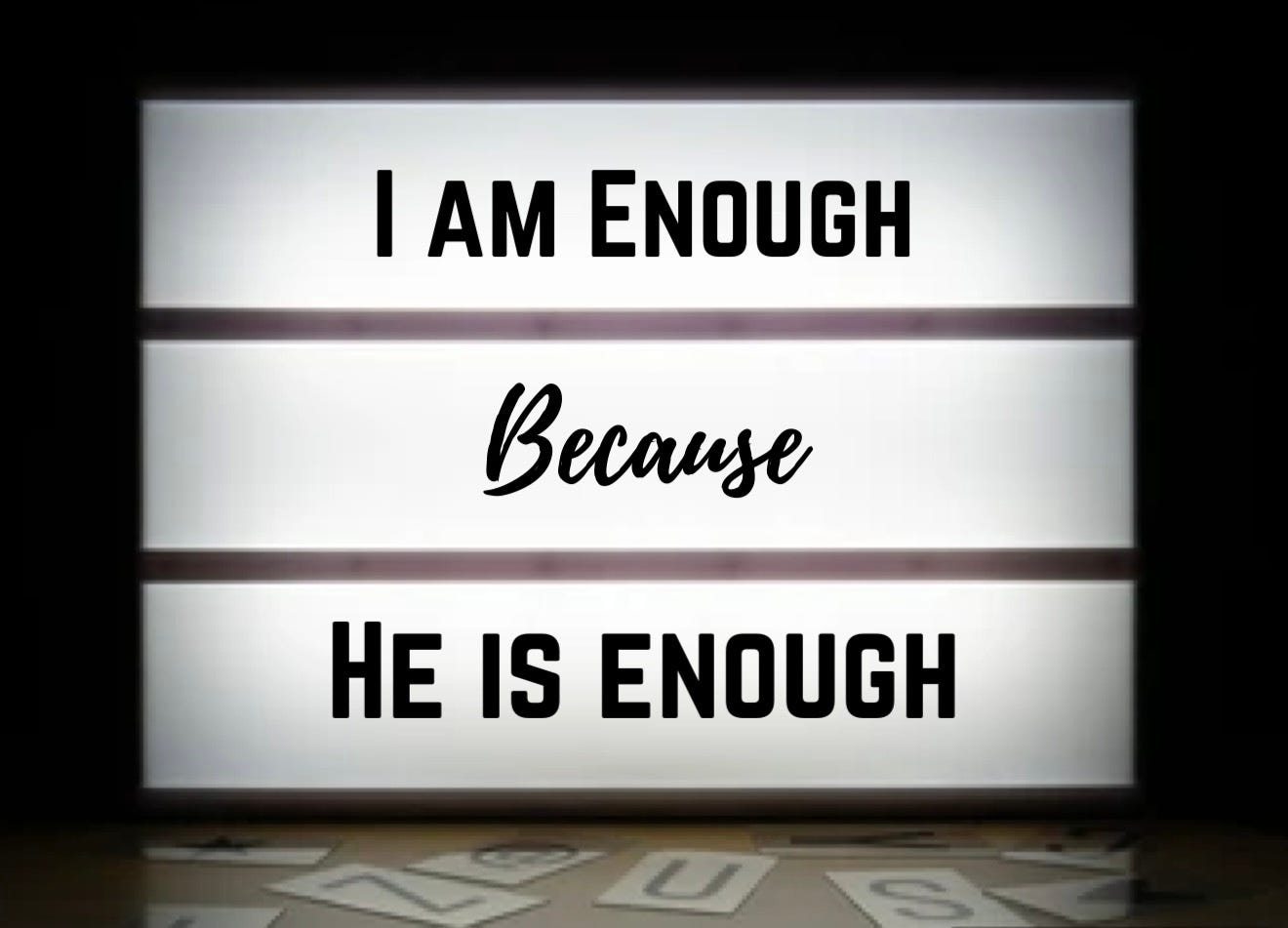
I firmly believe that if I am accomplishing these two goals, or aiming at them, I. Am Enough.
Here’s how I know. The guy on the middle cross said so. The thief basically says, “Don’t forget me when you leave.” Jesus tells him they will be together. God says that when we accept Him, we become heirs to His blessings. Not through what we did. But through what He did. And that’s the key. We are enough, because He is enough.
We Are Enough Because He is Enough
If we were left to our own accomplishments, we would be doomed. Through every move forward toward the ineffable aim, the indescribable telos, our dopaminergic system gives us a pat on the back to keep going. And with every step forward, we allow God to remove one more thing about us that doesn’t look like Him, allowing room for something to become a part of us that does look like Him.
As I spit out all of these truth-bombs, my wife stated that she still didn’t feel like she was enough. But she felt better. That’s because she now heard undeniable truth but had yet to identify and define exactly what would make her feel like she was enough. Now that she knows she is enough because God (in her) is enough, she can identify what, on earth, will make her feel like she is now enough. It must be reasonable and attainable. But this will cure the empty feeling.
If you are not yet at a place where you have identified what would be enough, sit down and figure it out. Because you can’t change what you don’t define. Now, earlier, I identified pizza as the best meal on earth, and right now I can smell it in the kitchen. So I’m out. Hopefully I won’t eat too much this time! Who am I kidding? Of course I’m going to eat too much. Because I haven’t defined what too much is yet!