

The Free Will Debate
- Jesus Targeted Hearts, Not Systems
- The Freedom of Limits
- Single Awareness Day
- I Forgive You
- Information Correctly Examined
This is in response to a 3–part series written by Dr. Steve Stewart-Williams. This post is a bit more philosophical than usual. I’m not smart enough to have real philosophical conversations, but I can converse on the subject of free will and how it applies to our everyday lives. Please know that this is written from the perspective of a Christian. So my angle is often from my belief, both intellectually and experientially, in the Judaic God.
We are in the process of looking for a house to buy. If you have ever done this, you know the next statement. It has been tumultuous to say the least. The ups and downs of buying a home is not for the weak of heart. In the midst of it, my wife takes a deep breath and says, “God already knows what house we will end up getting, He already knows what we desire, and He already knows what He desires for us, which is greater than we could imagine.” This was her way of coping with the stress.
This sparked a thought, just how much of this should we hold on to? Is it true that God already knows? The answer is yes. And here lies the biggest question: If God already knows, does this mean we are determined in our choices? Because if He already knows, this suggests determinism. But if we are determined to act, why wouldn’t we act solely in our own best interest, forsaking all others? Good question. Let’s tackle it.
Determinism vs. Libertarian Free Will
Dr Steve Stewart-Williams (SSW) addressed this issue in a robust 3-part series. First he tackled the issue of determinism, and more specifically, hard determinism vs soft determinism. Hard determinism can be viewed as the reluctance to accept anything as reality and that we are all merely in a sub-reality playing parts in another’s game. I’d like to leave that right where it is. Soft determinism (compatibilism) offers something more closely identifiable in that free will and determinism are compatible. This is in slight conflict with libertarian free will in that libertarian free will strictly rejects determinism and rest solely on the idea that we choose.
Definitions:
- Determinism: everything we do is already determined.
- Libertarian Free Will: rejecting determinism. we have the ability to choose.
- Compatibilism: freedom doesn’t require that our actions are somehow neither caused nor random. It requires only that our actions flow from our conscious desires, intentions, and reasoning processes. On this view, we have free will as long as we’re not unreasonably coerced or constrained by outside forces.
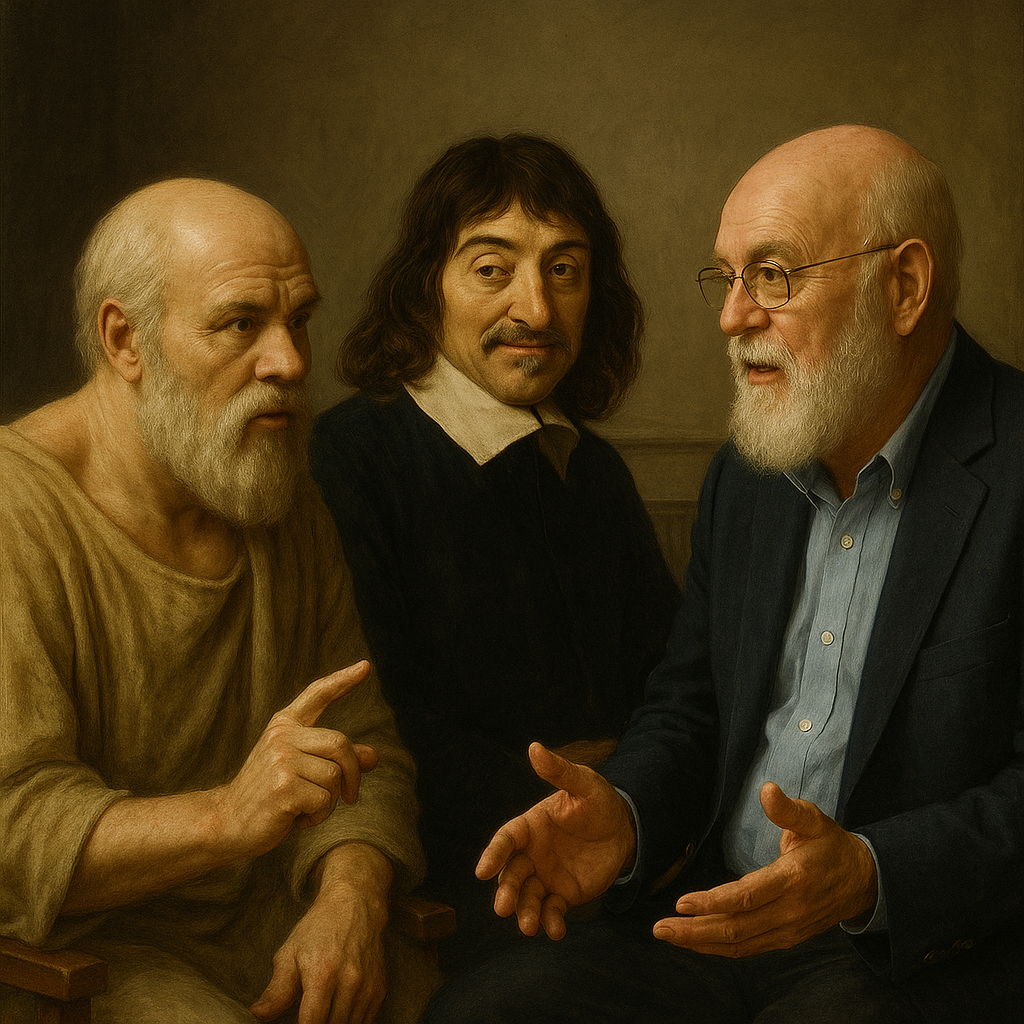
Dr. SSW briefly addressed the idea of mind versus matter and how this argument is not the same as the free will argument. And that’s true. I still think it’s a good place to start. Descartes was an early dualist. But he wasn’t the first.
- Pythagoras (6th century BCE) already hinted at a distinction between the soul and the body.
- Plato argued that the soul belongs to the realm of unchanging Forms (truth, justice, beauty) while the body is part of the mutable, deceptive physical world.
- Aristotle wasn’t so separatist in his view. The soul (psyche) and body (matter) were distinct but not really separate.
- Descartes built dualism into the scientific framework. Physicalists later formed in rebuttal to his theory of substance dualism.
- Carl Jung eventually highlighted such dualism in modern psychology. He also introduced the idea of spirituality as a result of his dualistic views. We are more than the matter that can be measured. We are made up of physical matter as well as archetypes and collective unconscious, structures in the psyche, disctinct from brain matter. This gives rise to my perspective on this issue.
Compatibilism
In part 2, he tackles compatibilism head on. Dr SSW writes:
Most compatibilists and most hard determinists agree on all the important facts. They agree that contra-causal free will is impossible; they agree that people frequently act voluntarily and without coercion; and they agree that it’s often useful to hold people responsible for their actions. The only real disagreement is about how to define free will. And that’s not very interesting.
Compatibilism strikes me as the most convincing view. It echoes the repeated disputes among early psychologists who tried to crown a single master key to the mind. Some swore by behaviorism, others by the machinery of the brain. Still others by conditioning or by self-understanding. One camp invoked genetics as destiny. Another pointed to the shaping power of environment. The trouble is that each holds a fragment of the truth. To all, I say, Yes!. The same pattern shows up in debates about free will. Certain moments in our lives are shaped by forces that run deeper than conscious choice. Such as our DNA, the temperamental leanings we inherit, the quiet impulses that orient us long before deliberation begins. In those moments, our decisions feel tethered to determinism.
Yet the outcomes of our choices unfold plainly before us, reminding us that we do in fact deliberate. We act from a conscious center, selecting what seems meaningful or right in the moment as we understand it. This is the footing on which we ground the very idea of holding someone responsible for what they do. Compatibilism makes the most sense to me.
Moralism
In part 3, Dr SSW dives into the moral argument. He writes:
If we don’t have free will, we can’t hold people responsible for their behavior.
If free will is an illusion, why bother being good?
If our behavior is determined, then rewards and punishments might influence people’s future actions. If it’s not – if it’s simply random – then they can’t. So, rather than undermining accountability, determinism seems to be the only hope for accountability.
Upon the treatment of criminals, he quotes Joshua Greene and Jonathan Cohen:
Free will as we ordinarily understand it is an illusion generated by our cognitive architecture. Retributivist notions of criminal responsibility ultimately depend on this illusion, and, if we are lucky, they will give way to consequentialist ones, thus radically transforming our approach to criminal justice. At this time, the law deals firmly but mercifully with individuals whose behavior is obviously the product of forces that are ultimately beyond their control. Someday, the law may treat all convicted criminals this way. That is, humanely.
My response here is, first, it is not obvious that criminal behavior is beyond their control. Secondly, I’m for restorative justice in almost every case. However, there are those that are more of a liability to society than a contributor. At that point, what’s best for the entire society may not be great for that individual. This is another arena where we must separate our feelings from that of good public policy. Feelings and policy are capable of both being good simultaneously and still not match.
Life Application
Lastly, he quoted Rousseau as saying:
I may think that I have rationally demonstrated my will is not free, but I can never succeed in believing or living as if this were so.
This is where the argument takes a severe turn for me. Because the free will argument dabbles into the conversation of objectivity vs subjectivity. If everything is determined, then everything seems to be subjective. And if everything is subjective, we have no gauge towards meaningful interactions.
Here is an excerpt from my new book, What is a Man:
[The reality in this argument has two places of interest. Verbiage and perspective.
Verbiage
In verbiage, we find that many believe that everything is subjective. No two people agree on absolutely everything. Therefore, there cannot be an objective set of values and morals. But the verbiage is off. The term objective morality never says that two people must agree on everything. It merely states that values and morals can exist outside of individual opinion. So, for example, there are no cultures in which you can steal someone’s property and it be widely accepted. It is objectively wrong to harm another human (outside of defense). I once read some philosophy on this subject and saw two good points of view. First, let’s look at slavery. While there are still areas of slavery in the world today, no one will openly state that it is a good thing or a moral thing to be a slave owner. Everyone inherently knows it is wrong.
Therefore, the objective morality around slavery exists. And if it exists anywhere, then it exists. It is the common-sense theory. There are certain common-sense areas where there is objective morality. Another point of view is that when two people disagree over something, it is something subjective. Some say Peyton Manning is the greatest quarterback of all time. Others would argue that he is not. This is a subjective principle. However, Peyton having won two Super Bowls is an objective principle. We can argue over whether he’s the greatest quarterback of all time, but we won’t argue over whether he won Super Bowls. This notion alone brings about the reality of an objective morality. If we can’t steal without causing harm, and we can’t enslave without causing harm, and we won’t argue over this being immoral, then it is based on an objective morality.
Perspective
The other place of interest is perspective. This one is as simple as the first. If you have the perspective that there is no possibility of an objective morality, then there is nothing to stop you from taking what you want and doing what you want without limitations on your behavior. You have no guide, no standard, no measuring stick. Nothing is off limits. This will inevitably produce strife, recklessness, chaos, pain, heartache, and suffering of all sorts. Anyone that’s lived for any amount of adulthood time knows this. Therefore, the perspective must be that there is a standard by which we all live. There must be an objective morality. Or at least there must be the perspective of an objective morality. The only real question for many is where this objective morality would derive from. My favorite psychologist once said, “I live as though there is a God.”
As Christians, we believe this objective morality comes from God and God’s word to us. But again, there is this perspective thing that creeps its head into the church. For instance, Calvinism. Calvinism is deterministic in the belief that God already knows everything, everything has already been determined, and your life is a predicted outcome of circumstances and events that will not change God’s predetermined mind as to who enters the kingdom of heaven. The premise was that one should live hoping to be that soul. There is a case to be made that this is factually true. However, the problem with this line of thinking is obvious. If your perspective is that God has already chosen who enters heaven, then it doesn’t matter how you live. There again, you find yourself having no limitations on your behavior, leading you right back down that hole of despair and brokenness.]
This is where the entire argument lies for me. Our perspective, and its effect on the quality of our lives. Dr. SSW noted a study where they found that when consequence was removed, people were nudged toward selfish, greedy, and unethical behavior. He noted that the study was flawed, but I think the point stands.
This can be viewed from the original sin lens. It’s now in our nature to do harm, wrong, bad. Therefore, if we are nudged in a manner that removes consequence, we dive towards selfish ambition. The tenets of God’s teachings are to deny our nature and take on His nature. This is what leads us to a more peaceful life and helps those around us thrive as well. Without this directive, our nature leads us in a path contradictory to our innate goals.
Conclusion
In the end, the perspective we carry shapes the arc of our lives. The question becomes how to use what we understand to grow into a sounder, steadier version of ourselves over time. When a perspective begins to wound us or those within our reach, it’s a signal that the lens itself needs changing. Perhaps God already knows the full story, but I don’t. Living as though I do only blurs my judgment. Whatever is fixed lies outside my grasp. What I can influence is how I meet the moment before me.
Stay Classy GP!
Grainger